Open Letter & Care Manifesto for Public Space

“Woolwich is a slightly crazy, colourful clothes wearing alcoholic dysfunctional aunt that you look forward to seeing.  She has great stories and makes you feel warm, but you wish she’d get some help. She has a calm peaceful side that not many people see.”

Woolwich Wandering Research Companion, Journal, May 2021

20 February 2024

Dear Royal Borough of Greenwich

This Open Letter is one of the outputs from a local, artistic practice PhD research project, Woolwich Wandering (2018-2024)[1] facilitated by Woolwich resident Lizzie Fort. Driven by Lizzie’s evolving artistic walking/wandering, pausing and resting practices, and ongoing work as a community dance artist, this research project positioned care front and centre of her practice. Asking ‘Am I Wanted Here?’ , the research explores the possibilities, tensions and knowledge that arise when an artist, resident and researcher considers the relationship with their neighbourhood. Woolwich Wandering has been an intimate, sited, artistic experiment, offering temporary spaces of encounter for Woolwich residents.

The purpose of this Open Letter is to share some care-full, embodied, and sensory perceptions of how Woolwich looks and feels, a collective sentiment galvanised from 25 residents who contributed to the project. It is hoped that these insights might, in some way, contribute to the council’s oversight of the regeneration of Woolwich to raise awareness of some deeply felt concerns and hopes for the future.

A brief note on the creative research activities, tools, and the project outcomes

25 residents contributed to this artistic practice project as companions in this research. During the Covid-19 pandemic in 2021, they walked alone and in their social bubbles, and kept journals, took photographs, created maps, and walk routes to document their relationship with Woolwich, followed by one-to-one online conversations with Lizzie. A few companions met in October 2021 for a wander on Woolwich Common and Repository Woods, followed by a chat at The Woolwich Centre library. Research activities continued into 2022, with four walking-resting workshops across the town centre, Royal Arsenal Riverside, Thames Path, Woolwich Dockyard and Woolwich Common areas. Each workshop closed with the writing of care manifesto statements about Woolwich. The fieldwork concluded with a public exhibition at  The Woolwich Centre, November to December 2022, displaying the companions’ contributions, as well as a draft Manifesto for Public Space.

Other products coming out of the research include an Interactive Map[2], and a podcast series ‘Sensing Woolwich’[3] that present the research findings in novel ways.  The project materials are documented on the Woolwich Wandering Website. The final, forthcoming written thesis will be submitted for examination in early 2024, with a viva (a conversation with examiners) expected in June 2024. The thesis will be made public after the examination process is complete.

We are aware that this letter and manifesto comes after the initial community consultation on key themes for the new Local Plan has passed and look forward to contributing feedback on the first draft of the Local Plan to be published in 2024.

A Care Manifesto for Public Space[4]

We are a small but mighty group of residents who, collectively, recognise that Woolwich is a wonderfully complex and contradictory urban place.

Woolwich is “diverse”[5], “vibrant”, full of “character”, “soul” and “personality”.

Woolwich is also “divided”, “troubled”, “scarred”, “neglected”, “gentrified”, “menacing”, “embarrassing”, “needing some help”, “dirty”, and has a “bad reputation.”

Woolwich is our neighbourhood.

We care about Woolwich, deeply.

We want future generations to feel part of this community and be proud of where they live.

Here is our care manifesto.

We care about green and water spaces. They are vital for our wellbeing, pleasure, and sense of connectedness to our community and nature. But our time, pleasure, and comfort in spaces such as Woolwich Common, St Mary’s Gardens, Maribor Park for example, is dampened because there are no public toilets and drinking water fountains. Better facilities please.

We care about borders NOT barriers. The public realm feels fragmented and disconnected. It is characterised by physical and sensory boundaries such as the smell, noise, and speed of traffic on roads, insufficient safe road crossings, badly lit, vandalised, smelly, and unsafe underpasses across the A206, high walls, fences, and locked gates. These boundaries negatively impact community connection, walkability, and our sense of place.

We care about places and worry about place-lessness. We recognise that regeneration is needed. But question whether developments are sympathetic to the diversity and vibrancy of our neighbourhood. Some of us recognise we are “middle class incomers”, contributing to and benefitting from gentrification of the area. We are not resting on our laurels. It is not ok for Woolwich’s long-standing communities to be displaced, or for them not to feel welcome in ‘new’ developments. Please support local, independent businesses and bring the high street back to life. And, when old buildings are demolished to make way for new developments, make sure those businesses that serve our global community are rehomed locally, with care.

We care about slowing down. Prioritise rest in public space. Moving and dwelling are off kilter. Moving dominates. Expand pedestrianised areas and 20mph zones, de-prioritise cars, build more safe road crossings. Accessible public spaces should have more invitations to pause and rest in safety and comfort throughout the seasons, without the need to spend money. More seating and tree shade would be a start.

We care about cleaning up Woolwich. Litter and fly tipping is a blight on our public realm and makes us feel embarrassed to bring our friends and family here. Royal Arsenal Riverside is pristine…what about the other side of the road?

We care about beautiful buildings. We have had enough of boring!We want to project heritage and see aesthetic variety. Build affordable, but NOT boring housing. No more “identikit” and “vanilla” buildings that are wounding Woolwich’s much celebrated character, and are bad for communities, our health, and the environment[6].

We care about spending our money in our neighbourhood. Support local independent businesses, not just well-known chains, to improve the retail, hospitality, and leisure facilities.

We care about feeling safe. We want to acknowledge and learn from tragic events of the past, such as 2011 London Riots, the murder of Lee Rigby in 2013, and more recent fatalities such as Cameron Murfitt (2020), Tamim Ian Habimana (2021) and Damilola Oloruntola (2022). Women should not have to walk home in the dark, clutching their keys in self-defence.

To close, we want to protect the global community of Woolwich, its character and variety of green and water spaces and heritage buildings, its entrepreneurial spirit, and independent businesses. We want to see it develop as a place that nurtures health, wellbeing, play, pleasure, prosperity, and togetherness. We envision a place where our diverse community can thrive.

In solidarity,

Lizzie Fort (lead artist-resident-researcher) in collaboration with,

Alexis Bailey, Anne Sophie Konan, Bianca Rus, Carol Flint*, Debbie Williams**, Duncan Platt, Ian Russell, Karin Tearle, Kate Topham, Lam Truong, Laura Love-Petschl, Lesley Turner, Liz McGine, Lucy George, Lyan Truong, Melloney Richards Tarka, Molly Rose, Patreace Parkes, Patricia Roud, Prince O Adele, Seiriol Davies, Sofia Alexandrache***, Tyron Woolfe, Anonymous1, Anonymous2, Anonymous3

[*Has since moved away. / **visitor, not a local resident. / ***Has since moved to another part of the Borough]


[1] https://woolwichwandering.com/. Funded by Arts and Humanities Research Council through the Techne Doctoral Training Partnership.

[2] https://woolwichwandering.com/interactive-map/

[3] https://woolwichwandering.com/podcasts/

[4] The concept of a care manifesto is borrowed and adapted from People United’s Futures of Care Manifesto. https://peopleunited.org.uk/stories/futures-of-care/futures-of-care-manifesto/

[5] “quoted” vocabulary from Woolwich Wandering research companions.

[6] See Building Soul with Thomas Heatherwick, https://www.bbc.co.uk/programmes/m001r1b2
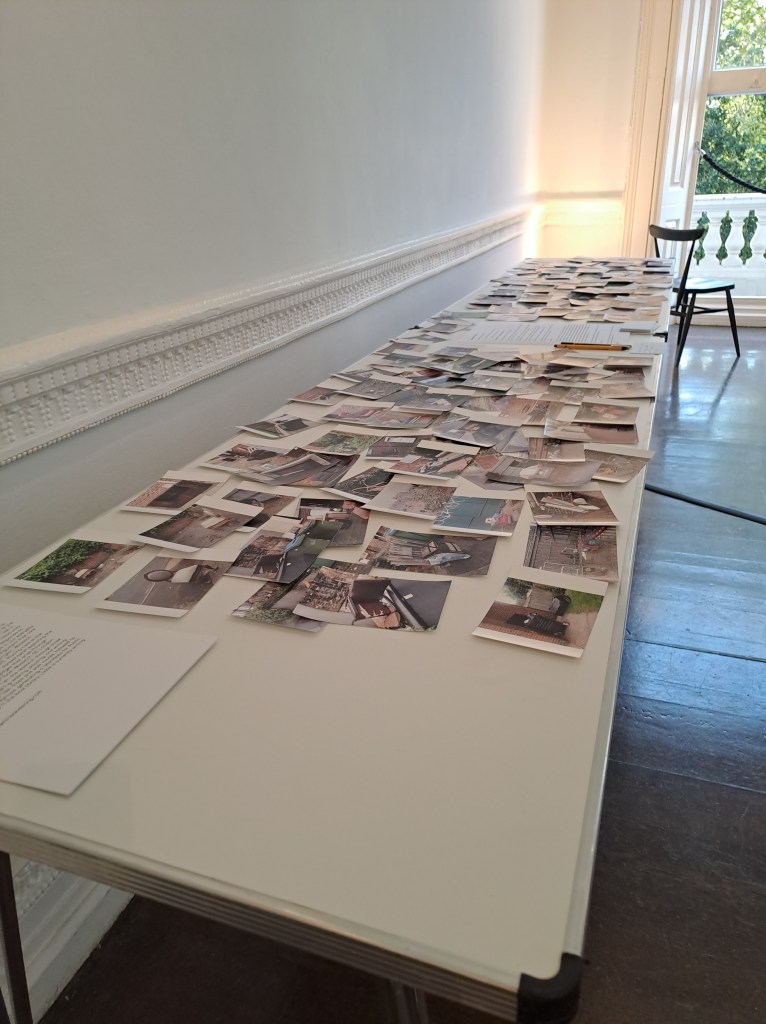
Decision Making in Practice Research

Abandoned Chairs (photography and text). 14 September, 2023. ICA, London.

Its been a while since I last posted…I’ve been preoccupied with writing up my thesis. In September, I had the opportunity to exhibit a small piece of work connected to this PhD project at an event hosted at the Institute of Contemporary Art. Taking the form of photography and text, Abandoned Chairs was a playful provocation about decision making in practice research, questioning what constitutes the practice of a PhD, and what constitutes a documentation of the practice. I questioned whether photos (and the practice of taking of the photos) of abandoned chairs may or may not play a significant role in my final thesis Caring and Sharing: Rethinking Community Dance as a Curatorial Practice. 

Here is the exhibition text, and some documentation of the exhibition.

An Exhibition of Wandering & Wondering

Next week I’m hosting an exhibition and live making of a new, local guidebook, ‘Woolwich Wonders’. I’m hoping people will come and work with the maps, walk routes, journals, photos, stories and anecdotes, and also bring their own new ideas to the curation of this new publication. It’s an opportunity to find new connections and meaning through the physical, collective tasks of gathering, connection, assigning, arranging, making and finishing a scrapbook. The intention is for this scrapbook be developed into a newspaper format in 2023. Please come along and spread the word!

Go back to the questions for the answers

In this PhD I am working on the edges of community dance practice, and at the same time driven by the core values or community dance, which is an odd but exciting paradox to be wandering through, literally and metaphorically.

What does it mean to be working at the heart and the edges of something all at once?

It feels like the practice is shifting about/around on the edges of a variety of related practices: community dance (as a participatory/socially engaged art practice) walking art, performance art and site-specific dance. It feels like ‘curatorial practice’ or the practice of curating is the connector of these related practices and that my role as an artist-curator is to navigate through a nomadic wandering between disciplines. The curating part is the meaning making, the sense making, the critical lens that makes sense of the edges and how/where they overlap and where they do not overlap.

It is slippery in nature, dodging definition and categorisation. I love this but also I have to grapple with the discomfort and uncertainty of this fluid position and its impact on my ability to make decisions about ‘what next’ in the practice, and currently, ‘how to share the practice publicly?’ and ‘what of the practice do I share for examination?’ and ‘how do I share it?’

In short, what does it mean to share something that is public, artistic and scholarly? Can I do all these things at the same time?

The shifting about of practices also happened in my Masters practice research thesis (Fort, 2015). My practice started sliding from community dance into curating. Calling myself an artist-curator, I concluded “The ecology of this community practice is defined by the co-existence and interaction of people, objects and space, and how these elements co-create one another.  This is one way thinking about collaboration and the collective voice.” 

And now, it would seem, the artist-curator role is the one that will help me make sense of what is at the heart, what is at the edges, and how do I curate the practice into something artistic, scholarly and public?

Having set myself a deadline of bringing the practice element of this project to a close – well, not a complete close, but a close for the purposes of the research project – by end of November 2022, I feel like I am unhelpfully bumbling about trying to decide what do share for a deadline which is just weeks away.

I decided to reach out to my network for help. I asked my previous teacher, Simon Ellis, now based at C-DARE, Coventry University, who writes the Practice As Research Blog

“I’m in the messy decision making process of how to share practice to close the public aspect of my project … and what to share for examination alongside the thesis. It’s the hardest part for me, surrounded by ideas and possibilities but also thinking “what’s the minimal viable product”? What’s good enough?”

You can read his helpful response here, taking me back to the research questions, or the “spine” of the project. I am also exploring this with other artist friends and scholars, as a way of learning from others and sharing solutions.

To close, these are the questions I am hoping will provide the clarity to move forward:

  • What way(s) of sharing will address the research questions of this project?
  • What is the minimal viable product? What is good enough?
  • What will reflect the values of community dance practice?
  • What is the role of artist-curator in finding solutions for sharing?
  • What is useful? (after Tania Bruguera’s concept of l’arte util)
  • How do I balance care for myself, my family, my project, the situation/context of the project – Woolwich’ and my research companions, towards this artistic-scholarly-public end?

Self Guided Wandering & Resting Experiences

Resting in the public realm is complicated. Rest is not safely accessed by everyone for lots of different reasons, bringing to the fore physical, social and cultural barriers to slowing down and being still when we are out and about.

Born out of my own artistic wandering, pausing and writing practice that has emerged slowly through this project since 2018, I have created some creative research activities that invite local people to document their own journeys, taken at a time of their own choosing.

A short audio briefing and 9 tasks to pick and choose from will gently guide people towards a mindful wandering and resting experience, asking them to document their discoveries along their route. The experience closes with the invitation to write statements for a Care Manifesto for Woolwich.

I hope that these activities act not only as an artistic and playful way to wander, but also enliven debate about safe, equitable access to the public realm. These activities also act as a participatory method of gathering important information about how people feel about resting, loitering, lingering, hanging out and pausing in public.

I hope that our Care Manifesto will be a call to action when its sent to Royal Borough of Greenwich’s planning team in a open letter in November 2022.

Would love to hear from you.

Take part – click here.

Letter to wanderers

This is the text from a letter I posted to the Woolwich Wandering participants last week. It captures some early reflections on their generous contributions to the project so far; their walking routes and maps, photo journals and our conversations.

—–

Hello

I took a moment to pause and reflect this week when I heard about another fatal stabbing in Woolwich at a bus stop on Woolwich New Road at 5:30pm; it filled me with great sadness and anger. This feeling was such a jarring reminder that among all the wonderful stories of Woolwich you and others have shared with me in the last few months, this darker, tragic and turbulent side of Woolwich rumbles away and rears its ugly head for the world to see in news headlines. A 14-year-old boy lost his life; another was seriously injured and has been arrested. In an instant, families are torn apart and changed forever.

I can hear a voice in my head, a familiar voice that some of you talked about in your journals and our conversations, the voice of people that said to you when you moved here ‘why would you want to move to Woolwich?’ with a bemused look on their face. Because they know this version of Woolwich from the headlines and cannot see past that.

Yet, yet, many of you, but not all of you, spoke so warmly about living here, about your choice to be here despite these uglier sides of SE18 that remind us that its sometimes complicated. 

I think this complicated relationship with Woolwich is well summed up by one of your journal entries:

“Woolwich is a slightly crazy, colourful clothes wearing alcoholic dysfunctional aunt that you look forward to seeing.  She has great stories and makes you feel warm but you wish she’d get some help. She has a calm peaceful side that not many people see.”

Many of you found this calm, peaceful side during the pandemic; for example, some of you discovered Woolwich Common for the first time as you ventured into its wild centre beyond the busy road boundaries.  Others found tranquillity by the River Thames, which unsurprisingly was one of the pop stars to emerge from the research so far.

Some of you who, like me, are relative newcomers to Woolwich; some of you have lived here all your lives; found love here; moved here to start a family; and one of you has moved away since contributing to the project. I think most of us agreed with the sentiment that Woolwich needs to get some ‘help’; and we spoke a lot about the local regeneration projects that are positioned as helping Woolwich move forward.

Many of you expressed with acute awareness that you benefit from all these new plans for the area but you had concerns about what might have happened to previous residents who have been moved on; you spoke of social cleansing and gentrification. Some of you live in the new buildings in the town centre and riverside. Others live away from the centre towards Charlton, Shooters Hill and Plumstead. Many of you spoke about your excitement about the upcoming creative district, Woolwich Works, with thoughts on this area being billed as a tourist destination; a real mixed bag of positivity about supporting the local economy juxtaposed with concern about who is being left behind in these grand cultural plans. Nearly all of you talked about ‘The Road’ as a physical, cultural and social barrier between the town centre and Royal Arsenal Riverside. Some of you rarely visit the town centre because it does not provide what you are looking for in terms of shops, socialising and leisure, choosing to go to other local spots like Greenwich in your spare time. All of you spoke fondly about the local green spaces and some of you highlighted issues with disconnected spaces, access and a lack of safe road crossings. The Military presence seemed overall to be welcomed, with The Kings Troop cited by many of you as a local treasure.

In the last few months of getting to know you and all the other local people who have generously written journals, taken photos, made maps and walking routes, I have experienced many joyful moments of connection.  Your creativity and care in completing the tasks has really blown me away.  I have been walking some of your routes and visiting places that you have introduced me to and been thinking about how we might all come together and consider ‘what next?’ for this project. I wonder how we might do something light, social and meaningful that celebrates your Woolwich with others.

Woolwich is complicated and perhaps a little lost. Maybe this is part of its mystique and charm, or not. Is it possible that as a collective we can play a small part in helping it find its way?

So…with this in mind, how we might move forward?

I am taking a two-month break in July and August from the Woolwich Wandering project to undertake a work placement with Luca Silvestrini’s Protein Dance, a local company that will be moving into the Woolwich Works building this Autumn. I am helping them in their production EnRoute, which is a promenade experience that starts on Woolwich Common and finishes on the Royal Arsenal Riverside, running daily from Tuesday 26th July to Sunday 1st August.   This is the link for more information if its something that interests you. https://proteindance.co.uk/production/en-route/

When I return to the Woolwich Wandering project in September, I would like to invite you all to take part in a group meet up, to reflect on where the project is now, and where it might go.  This will probably be hosted in an outdoor space such as The Garrison Church, as one of you suggested.  Date to be confirmed. I will be in touch nearer the time to find out your availability.

In the meantime, if you have any thoughts or suggestions on locations, format etc, do get in touch.

And so to close…as I finish drafting this letter to you, England have made it to the final of the Euros and by the time this letter arrives on your doorstep the game will have been played and the Prime Minister will have made an announcement about the lifting of Covid restrictions. As we enter a new phase of the pandemic, I wish you all the best of health and happiness and hope you are finding things in your days to make you smile.

Lizzie

Reading about writing : a helpful act of procrastination

Feeling a bit stuck with the writing bit of the PhD. So in an effort to get unstuck, I have been reading about critical creative-artistic-performative writing. Reading this now it feels like this action is an act of procrastination. Perhaps it is! Rather than getting on with the writing I will read about writing. It sounds ridiculous. But I am sticking to my guns and claiming it is helpful.

Reading is from two sources:

The Creative Critic: writing as/about Practice (2018), edited by Katya Hilevaara and Emily Orley1, and article How We Talk About The Work Is The Work in Performance Research by Theron Schmidt (2018)2.

Here is what what I have learned:

Borrowing Peggy Phelan’s famous phrase, Theron Schmidt concludes his article:

“Critical writing can become ‘something other’, a practice in its own right, in both senses of ‘practice’: it is something to be practiced, to be cultivated – something we can get better at, making discoveries through working more closely and deeply with the task. As writers we can learn from other writers. And also: it is a practice among other creative practices. We can learn from other non-writing. We can find ways of using the rhythms and scores of architecture, dance, daily life. From other fields we can borrow terminology and jargon, methodological approaches and forms of composition.” (2018)

This feels pretty spot on and sums up some of the reasons I am feeling stuck and overwhelmed. I am ‘borrowing’ from fields beyond the safety of my main practice, community dance, to make better sense of it. In a somewhat panicky email to my supervisors Efrosini Protopapa and Sara Houston at Roehampton University last Monday, I said:

“There seems to be so much to read and write about…

Walking/flanerie/Psychogeography

Site dance/choreography

Community dance/participatory arts/socially engaged arts

The everyday

Care/care ethics/ethics

Place/Urban planning/placemaking/regeneration/gentrification

Woolwich

Civic role (of arts)

Outsiderness/tourism/hospitality

Local/localness

Chairs

Attention/distraction (affect theory?)

Writing about practice methodology/methods

The curatorial (not been on radar much recently)”

and “Wider contextual issues seem relevant to write about too, for example: Impact of covid, social justice movements, climate emergency, Sarah Everard case walking safety. Perhaps these form chapters of their own, or one chapter that covers how all these things have impacted the project.”

I think I am overwhelmed by feeling that to write as and about the practice is to write in the context of all these things. I need to identify: what is central and what is a distraction; what will be part of the contextual, background literature review; what is integral to the multi modal methodology that borrows from different fields; what is the critical writing about the practice; and finally what is the public sharing of that practice and subsequent writing about that ‘event’ that might continue the “resonances and reverberations” (Schmidt) of the practice?

Hilevaara and Orley’s introduction to their book talks about the different ways of referring to writing as/about practice: Robin Nelson’s complimentary writing; Henk Borgdorff’s writing alongside practice; Eve Kosofsky Sedgwick’s writing beside practice; Irit Rogoff’s writing with practice. There are calls to not be shackled by categorisations of writing that include performative writing, art writing, auto-ethnography and others. I do like their inclusion of “Writing-beside involves, first and foremost, an attending to, a listening, a level of care. A methodology that P.A. Skantze (drawing on the work of Sebald) calls a narrative of care” since care is a central concept of my research. Perhaps it is writing about a practice of care through a narrative of care.

To close, for now, the practice of this PhD can be described as a walking, dancing and choreographic practice that is being researched through the lens of care, is situated in the public realm and is responding to issues in the public realm, like regeneration, gentrification, access and littering. I think next time I might need to interrogate the concept of public further, so will end on this note from Schmidt who refers to Suzanne Lacy’s writing:

Schmidt says “The idea that ‘public’ is a thing that is manufactured, that is tested and contested, became the focus of what Suzanne Lacy would describe as ‘new genre public art’. A shift out of designated spaces for art and into city landscapes, domestic dwellings and specific communities, meant that ‘public’ was no longer a term that could be taken for granted, but must be considered one of the things that the artist is actively making:

‘Is ‘public’ a qualifying description of place, ownership, or access? Is it a subject, or a characteristic of the particular audience? Does it explain the intentions of the artist or the interests of the audience? The inclusion of the public connects theories of art to the broader population: what exists in the space between the words public and art is an unknown relationship between artist and audience, a relationship that may itself become the artwork.’ (Lacy 1995: 20)”

More on that and the publicness of writing another time. When I have finished procrastinating on this.

References

  1. Hilevaara, Katya and Emily Orley. Eds (2018) The Creative Critic: writing as/about Practice. Routledge: Oxon
  2. Schmidt, Theron (2018) How We Talk About The Work Is The Work, Performance Research, Vol .23 (2). pp 37-43.

artist – tour guide – lollypop lady

This week’s walks couldn’t have been more different; Monday’s sunny, windy walk along the Thames, through an industrial area and into a small green space tucked behind the Thames Barrier contrasts with Thursday’s chilly, fresh and damp walk through Marion Wilson park with paths that meander through the trees and patches of brilliant bluebells. Both walks were with one other person who I have met once before. As I settle into the Stride on Time project1, I have been thinking about my multivariant role as a local dance artist who is planning and delivering dance inspired walking experiences in Woolwich and Charlton.

The role flipflops through different identities of artist, tour guide, pedestrian and lollypop lady. As ‘artist’ I lead a creative activity to tune the body and the senses to the place and play choreographic games with pedestrian movement. On the Thames walk I attempt to offer some poorly patched together historical information, tripping over fragmented memories as I retell stories about The Royal Iris, an eerie, derelict, lop sided, retired party boat from Liverpool that is slowly sinking by Thameside Studios…something about The Beatles, something about Cardiff, something about The Mersey. I’d be a terrible tour guide, I think to myself. Continuing on, I ensure we can safely cross the road together. As our walks come to an end I might be called upon to advise on the nearest bus stop to travel home. I am surprised about how much I do know about getting about in my neighbourhood, which has largely been fuelled by being a dedicated, mindful pedestrian and paying attention to what’s where and what’s what.

Applying choreographic thinking to planning and delivering these walking experiences is, I think, helping to craft meaningful encounters with place.

For example…

In the park walk we take time to notice the nearest and farthest points that we can see; we map a journey from one to the other. We walk to three of these farthest points via a route that I lead since the network of paths and how they connect the selected points are more familiar to me than my walking companion. We talk about Mental Health Awareness week and the theme of nature2, and she tells me about a book her daughter is reading about fungi and how trees and fungi communicate to look after one another. It reminds me of The Care Manifesto: The Politics of Interdependence by The Care Collective3, and the shared vulnerabilities of being human and how we might develop more effective caring networks.

I introduce Steve Paxton’s ‘walk sit stand’ score in Monday’s walk and my companion connects walking backwards to her Chinese culture.4 I use this exercise again on Thursday but instead of ‘sitting’ on the wet grass, we ‘lean’ on trees. Its playful and my walking companion comments on the joy of connecting to childhood as we chat on the way back.

As the third week of leading these new dance inspired walks comes to a close, I am curious about the mindset that I carry into and through the walking experiences. I am finding that a loose and flexible approach is emerging that includes: body/senses tuning in; a journey to a location with time for chatting; a creative exploration of that location; a playful choreographic improvisation or game; a journey back with time to chat and reflect on our shared experience.

The people I walk with are making connections to home, place, nature and family during our time together and its a joy to share these moments with them. Come rain or shine, this local lollypop lady is happy to guide these somewhat unconventional artistic tours and say ‘STOP’, pause here with me for a little while and absorb everything it has to offer you today.

  1. https://greenwichdance.org.uk/whats-on/filter/classes/
  2. https://www.mentalhealth.org.uk/campaigns/mental-health-awareness-week
  3. https://www.versobooks.com/books/3706-care-manifesto
  4. https://woolwichwandering.wordpress.com/2021/05/10/retro-walking/

Retro Walking

Have you ever walked backwards in a public space for a few minutes?

It is really quite liberating! I am sure the two gardeners working on the flower beds must have thought we were a little bonkers but we had a lovely time. In today’s Woolwich walk for the Stride on Time project with Greenwich Dance1, we set out walking forwards along the river from Clockhouse Community Centre, followed the cycle path through Thameside Studios and found a quiet green space tucked behind the Thames Barrier on the south side of the river. Picture a circular path around a green centre with benches framing the outer circle.

Starting with the a simple set of choreographic rules; walk, sit and stand, borrowed from the contact improvisation pioneer Steve Paxton and his work Satisfyin’ Lover (1967); we set about exploring this little space for a few minutes, and spontaneously started experimenting with walking backwards. As we passed each other one of the participants commented that in Chinese culture walking backwards is a regular pastime and connected to wellbeing. So we did it for a bit longer and noticed it was working different muscle groups, required more concentration and was actually very mindful…mainly to avoid tripping over or bumping into something/someone.

After a little more digging on the internet at home, I found out that its connected to Traditional Chinese Medicine and karmic reversal or correcting mistakes from your past.

“100 steps backwards are worth 1000 steps forwards”

And there are studies that have shown the benefits of retro walking, including boosting short term memory2, health and wellbeing3.

I am left questioning…

In the act of walking backwards are we more connected to our self as a body moving through space and time, more so than walking forward?

Are we therefore less connected to the space as a ‘place’ since retro walking requires our senses to be more heightened in prioritising safety and avoiding potential obstacles?

If we practice retro walking and get better at it does that mean we can do other things while retro walking (like we do when walking forwards)?

The mindfulness element of walking seems to be experienced very differently when walking backwards, compared to forward motion. What are we mindful about in both experiences?

Will I get funny looks if I do it in Woolwich?

Does anyone else walk backwards regularly? Would love to hear from you!

  1. https://greenwichdance.org.uk/whats-on/filter/classes/
  2. https://www.health.harvard.edu/mind-and-mood/can-you-boost-your-memory-by-walking-backward
  3. https://www.healthline.com/health/fitness-exercise/walking-backwards#Why-walk-backward?-