Am I wanted here?

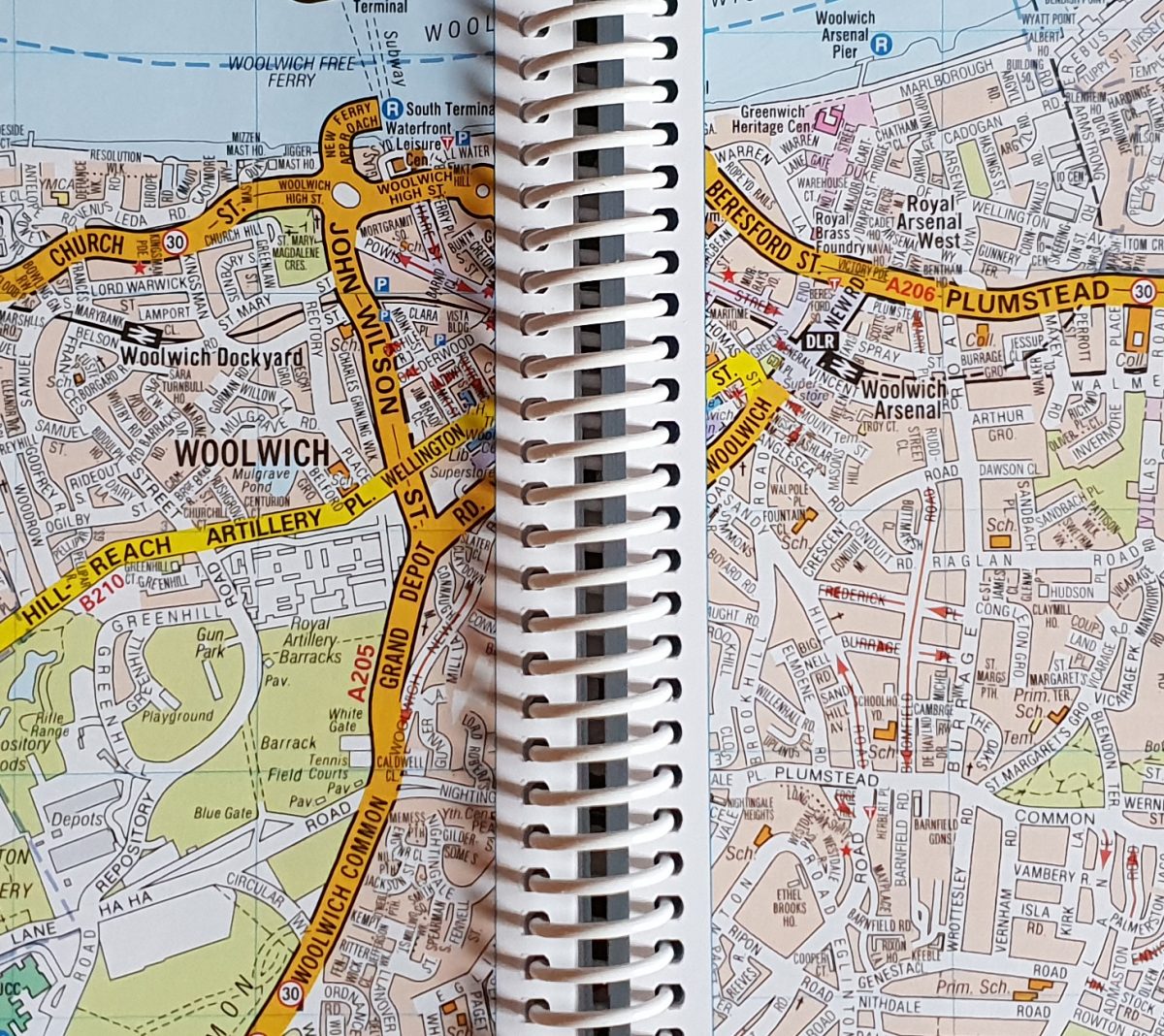
This isn’t a cry for help or call for attention or confidence boost or an attempt for some sympathy. This is a genuine question I am grappling with as a local artist who already works in Woolwich, but who seeks to work in a more meaningful, empathetic and responsive way in my practice, in and with my local community.

In 2010, Lucy Lippard an American writer, art critic, activist and curator asked…

Is the artist wanted there and by whom? Every artist (and anthropologist) should be required to answer this question in depth before launching what threatens to be intrusive or invasive projects (often called ‘interventions’)

(Lippard 2010: 32)

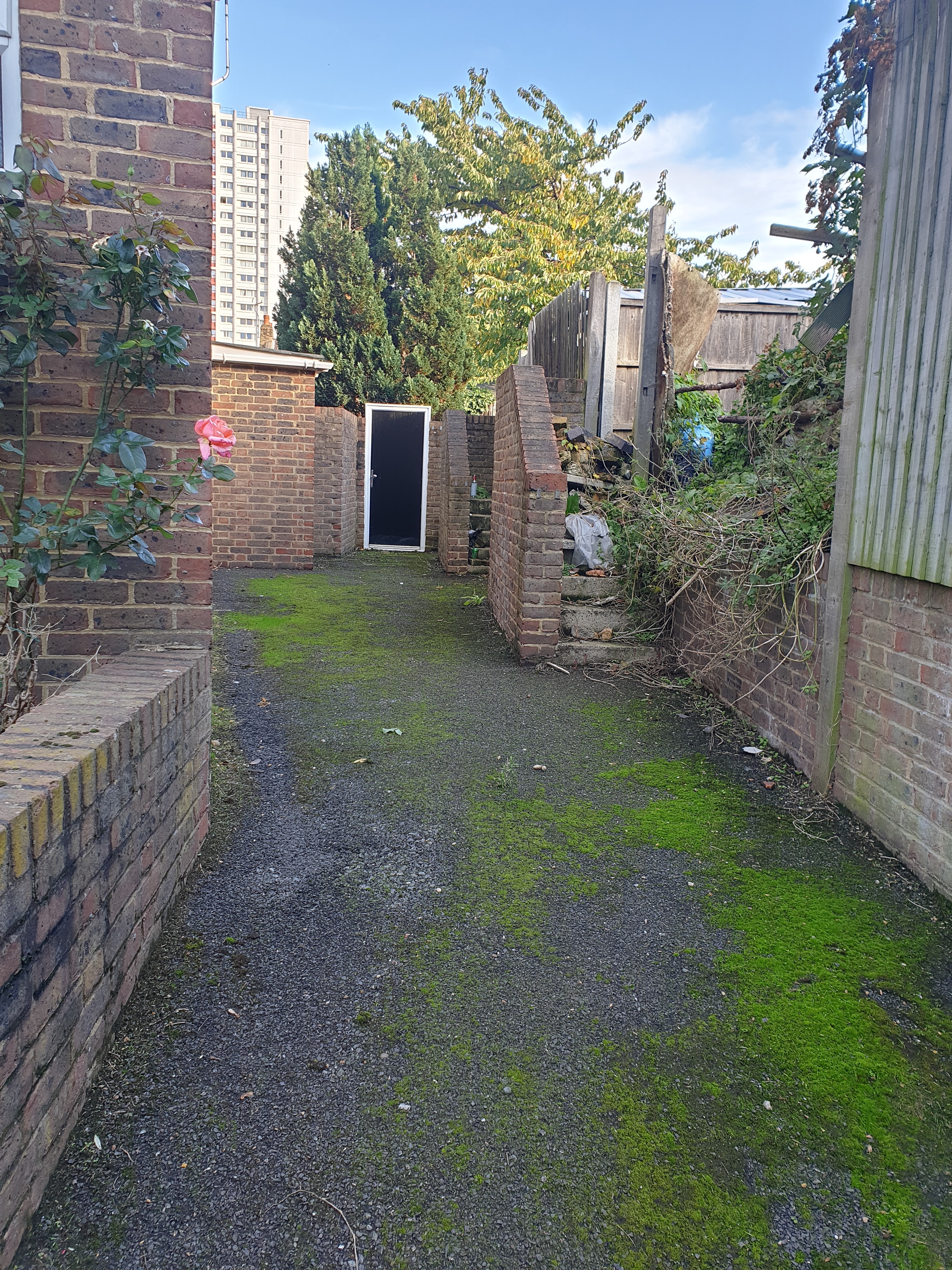
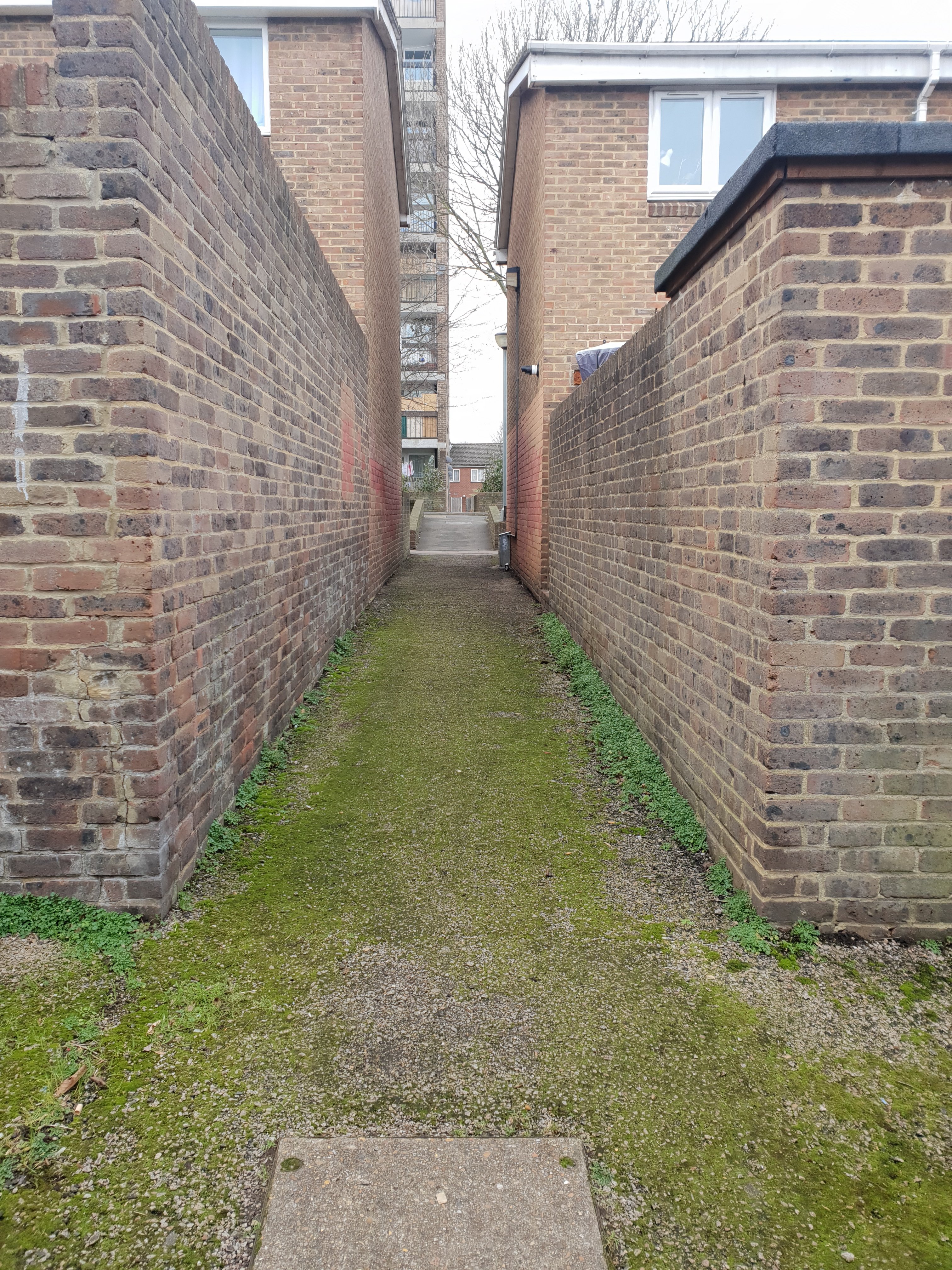
I asked myself this before writing my PhD proposal. I didn’t know the answer then and so was very mindful of creating a concept for an artistic project that enabled me to be projective and not prescriptive. This led to thinking about my own experience in this neighbourhood as a resident and how much I didn’t know about the place and the people. I quickly progressed to feeling a sense of outsiderness, of being a tourist (although I didn’t have a guidebook or tour to follow) and took this gaze with me on my walks. Each walk felt like an expedition, a discovery of: the physical spaces – the streets, the dead ends, the green spaces, the alley ways, the shops, the market places, the civic spaces, the Military land and buildings, the barriers, the open gates, the building sites, the transport links, the road crossings, the stairwells, the underpasses, the river, the common fly tipping sites, the houses, the driveways, the front gardens; and the people that bring meaning to these spaces.

This sense of being an outsider, of being on the back foot, as a newbie in Woolwich was humbling and I hope, respectful. It was also sponge-like…absorbing the place with every walk, and every pause and every encounter with others. Some encounters were fleeting, others involved a brief conversation, and one led to an invitation to lead dance classes with a group of Vietnamese women on Thursday mornings at Woolwich Common Community Centre from May to October 2019, just before I took maternity leave for a year.

And so to thinking about where I am now with this project. In January I begin a process of getting to know the people of Woolwich better through what is described as creative ethnographic research tools: photo journals, photo elicited interviews and walking conversations. I hope to gently find out a little more about their everyday lives, the places that matter to them, and their experience of Woolwich in is current transitional state.

This way of working as ‘artist as ethnographer’ is not new. Its described by art critic and historian Hal Foster (1995) as the ethnographic turn in contemporary art in the 1990s. In their introductory article to the issue of Critical Arts (Issue 5, 2013), Kris Rutten, An van. Dienderen and Ronald Soetaert summarise this approach as blurring the boundaries of the fields of art and anthropology, leading to a third space or borderland that crosses disciplines. Where “art projects are presented as (a kind of) ethnographic research and ethnographic research is presented as (a kind of) art. ” (Rutten et al 2013, pp460-461)

I am clear that I am not producing an ethnography of Woolwich. I will not be speaking ‘about’ or ‘for’ the Woolwich residents who choose to take part in the research. The photo journals and walking conversations provide a creative place for residents reflect on what it means to live here.  The relationship between artist and subject will always be unequal no matter how much you work at providing an inclusive and accessible way into participation. And so, it is important to foreground this inequity and try to instead do what film maker, writer and composer Trinh Minh-Ha suggests, to speak ‘nearby’. Should participants consent to sharing their contributions in a collective exhibition of sorts, I will facilitate this…which also requires me to grapple with the messiness of co-authorship and attribution. Ultimately, I seek to benefit from this project since it forms part of my PhD, for which I receive a scholarship. Participants in this research are volunteers with expenses covered. And so the ethics of this work are ever present and challenging and I wrestle with solving these issues so that the project does not become intrusive or invasive, as Lippard warns, or for that matter, unethical.

So to answer Lippard’s question, “Am I wanted here and by whom?”  I guess I will find out next year.

The completion of this phase of the research in 2021 will mark a significant pause and moment of reflection before planning what will and won’t come next.

References

Lippard, L. (2010) Farther afield. In Between art and anthropology, contemporary ethnographic practice, ed. A. Schneider and C. Wright, Oxford and New York: Berg.

Kris Rutten, An van. Dienderen & Ronald Soetaert (2013) Revisiting the ethnographic turn in contemporary art, Critical Arts, 27:5, 459-473, DOI: 10.1080/02560046.2013.855513

Foster, H. (1995) The artist as ethnographer? In The traffic in culture. Refiguring art and anthropology, ed. G. Marcus and F. Myers, 302–309. Berkeley, LA and London: University of California Press
reading walking

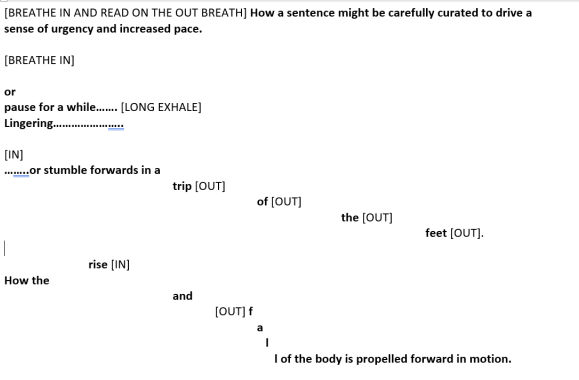
Walking to Woolwich Common last week (10.12.2020) I started to think about the relationship between walking and writing and the type of writing that might be useful at the moment. I had been flirting with the idea that there is a relationship between walking and writing, one step after the other, one word after the other, with pausing on walks acting as a sort of punctation. I wondered about writing in way that conjured the rhythm of walking for the reader and how words on a page might be designed to visually enhance this embodied sensation during the normally sedentary activity of reading.

And so, the words are choreographed on the page with breath prompts to somehow communicate for the reader an embodied representation of the walk itself.

Tricksy. 

I am not sure if it works.

what is this practice?

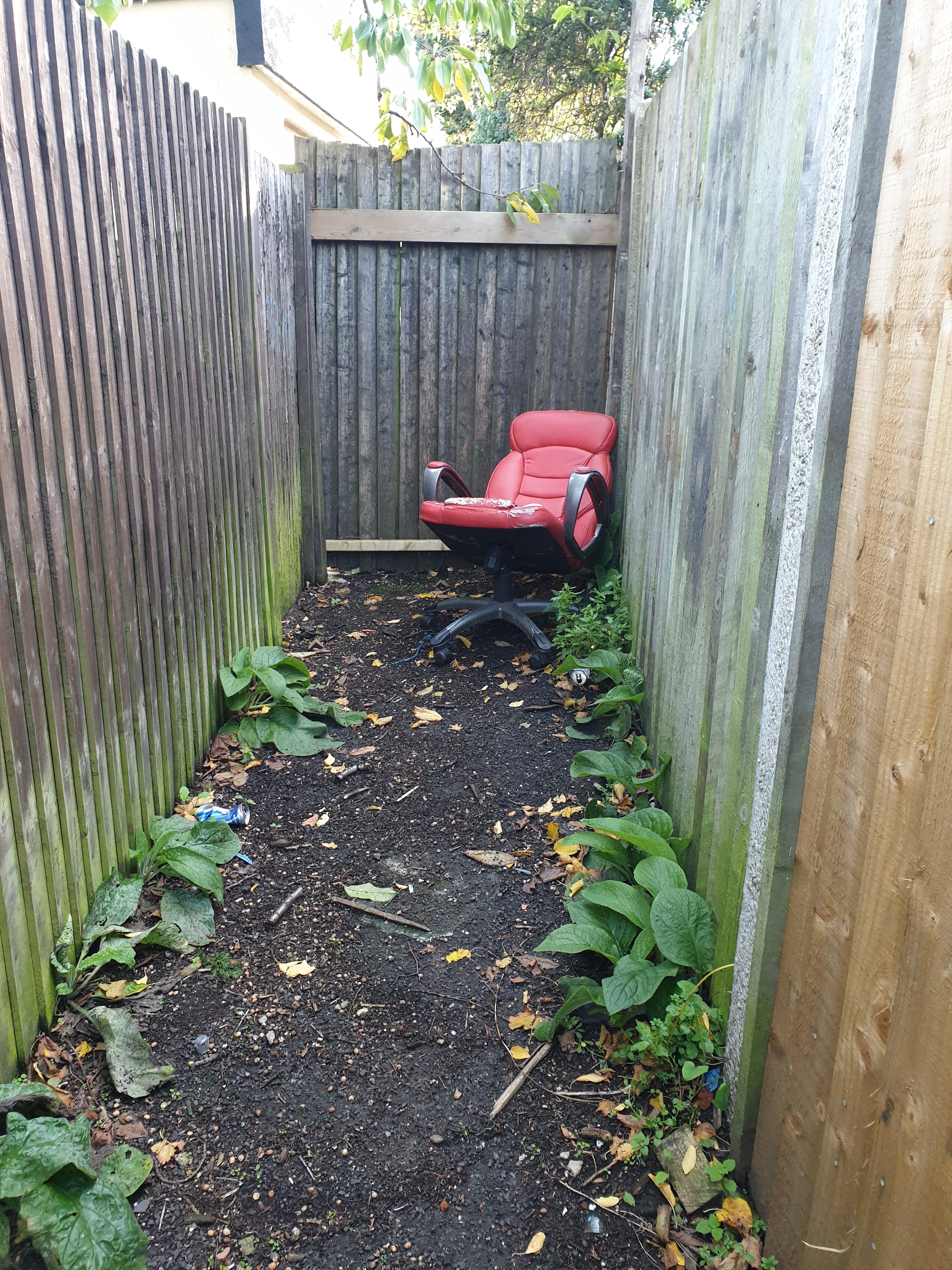
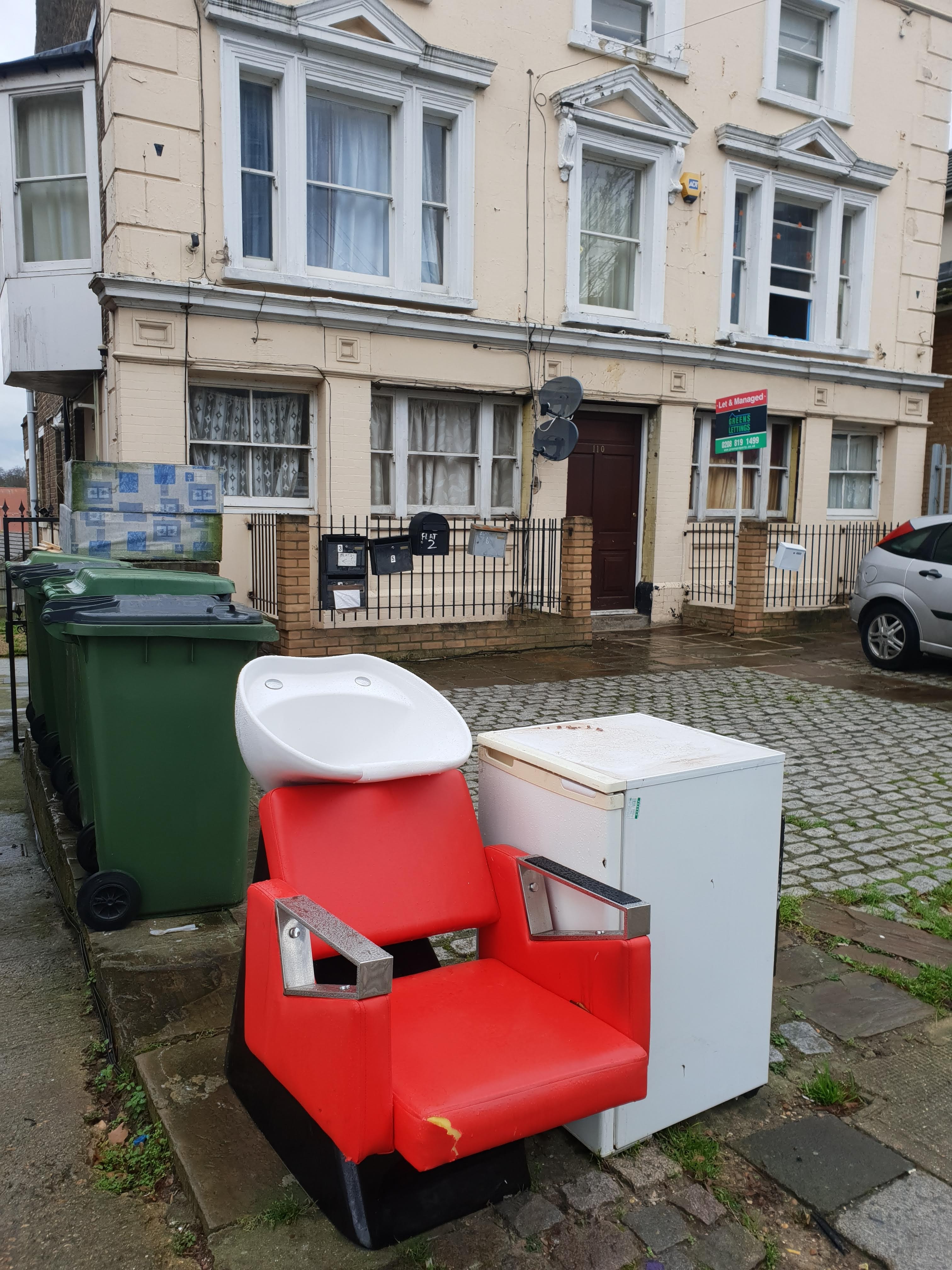
its walking. its pausing. its taking photos. its taking photos of discarded chairs, empty chairs, fly tipped chairs and other incongruent objects that disrupt the status quo. its smiling and saying hello to passers by. its notating the route as a bulleted list of roads and sites of interest. its reading about these sites. its people watching. its wandering and wondering about walking, pausing, caring and sitting with place and with other people. its sitting for a while in a public place with a flask of tea and watching. its walking my dog. its a solo practice and a shared practice with my daughter and husband sometimes. its following instincts and interests. its projective. its intuitive. its still open but it is becoming more defined; a score or set of loose rules is emerging, slowly.

Firsts

Our daughter took her first steps on Sunday 25th October. We were all playing on the floor in the living room as she quietly took herself towards the sofa and pulled herself up for her usual sideways scooting action along the cushions. Yet this time she turned around and leant back, standing for a while, looking at her Dada. She steadied herself and launched forward with a look of determination, right, left, right, tumbling with glee into Gav’s arms. We all screeched with excitement “again again again” as the Teletubbies say. She quickly crawled back to the same starting place, over and over. She had of course already experienced the rhythmic movement of walking in my womb, lulling her to sleep in the day then waking up with the flutter of kicks and punches as I lay down to sleep at night. And after she was born she would snuggle into my chest in the sling as we ventured out and about, often falling asleep to my wandering motion. Later when she was able to hold her head up she faced front in the sling, eagerly following the dog around the park each day, reaching out to touch leaves and bushes, little legs dangling and kicking about below. At home, in her own time she started to pull herself up to stand against the sofa, scoot sideways, and eventually push a little trolley with books and toys back and forth from the living room to the kitchen, banging into anything that got in her way. Next she braved standing unaided, balancing and waving the TV remote controls like a conductor. And finally, at 11 months old she plucked up the courage to put one foot in front of the other, toddling, turning, tumbling, repeat.

The next day marked the third week of PhD study since returning from maternity leave. I had set an intention to focus on the interrelationship between walking, writing and reading, re-engaging the physical, emotional and cognitive muscles that connect these practices, now with the added lens of motherhood. Like my daughter learning to walk for the first time, there are many firsts for me in this new chapter. I am learning how to balance my PhD and being a mother, and how motherhood impacts and influences my practice research.

And so I started the week with a solo walk to Bloomfield Road and Brookhill Road and discovered some smaller roads, paths and cut throughs that I hadn’t taken before. Notable finds were: a multitiered mews of terraced houses off Raglan Road that created an intimate performance space (pictured); trespassing through the carparks and grounds of two old Victorian schools, now converted into housing; and two large, dramatic, steep stairwells connecting Brookhill Road to Elmdene Road and Sandy Hills Road.

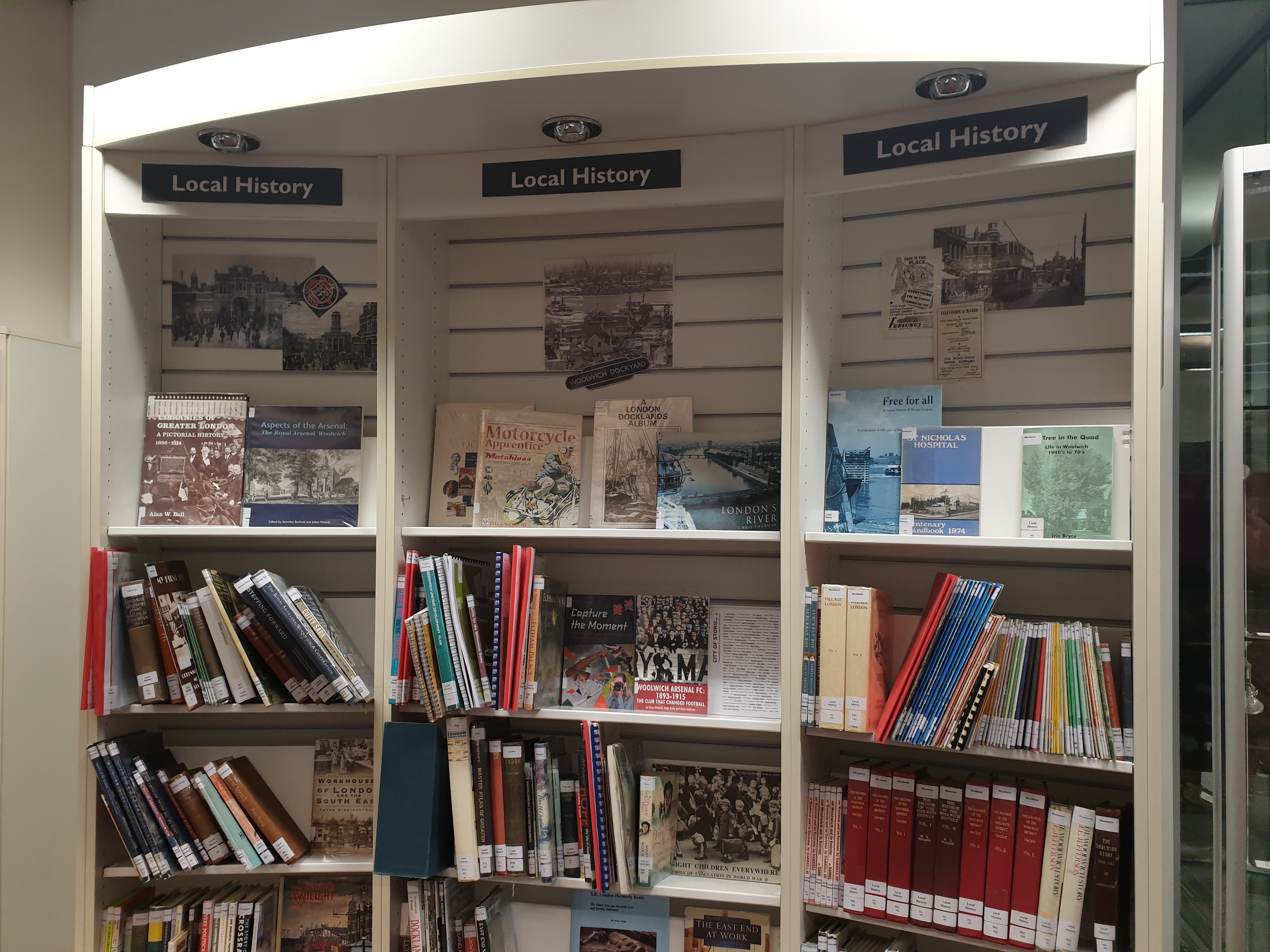
A quick on-the-hoof Google search of the stairwells off Brookhill Road led me to discover an online reference to the 500 page Survey of London Volume 48: Woolwich (Guillery, 2012), prompting a trip to my local library’s local history section.

The Woolwich Centre Library

And so walking turned into reading; wide eyed like a kid in a candy shop, I flicked through Guillery’s comprehensive history of Woolwich people and place excited at the prospect of unearthing stories and context to embellish my lens of Woolwich. Later in the week I also started reading the introductions to two books this week, Ways of Walking: ethnography and practice on foot edited by Tim Ingold and Jo Lee Vurgunst (2008) and Walking, Writing and Performance: autobiographical texts by Dierdre Heddon, Carl Lavery and Phil Smith edited by Roberta Mock (2009).

And so, this leads me to writing on this blog for the first time since February 2019. Neglected but not forgotten, the blog was deprioritised as I fell pregnant in March 2019, just as I was undertaking a five-week artist residency, TOURIST 1 at Clarence Mews. The fatigue and the need for a greater attention to self-care for me and my daughter who was growing inside me took priority. While the blog was silent, I was still wandering the streets of Woolwich, meeting new people and groups, reading and writing in other mediums. Walks were usually followed by an afternoon nap. One of my walks took me to Woolwich Common Community Centre where I met a group of Vietnamese women who I went on to lead dance sessions with weekly until September 2019.

In these months before maternity leave instead of writing for the blog, I was writing two PhD forms that are key milestones for progress; an expanded research proposal document that sets out the rationale for the research, literature review, aims and outcomes and what new knowledge my project will contribute; and an application to Ethics Committee setting out the intended research design and ethical considerations for working with people. Both processes were helpful in some ways but raised significant challenges in trying to avoid feeling fenced-in by commitments of what I would do, when, how and with whom. I want to work in a responsive, intuitive and projective way that isn’t shackled by a prescriptive research design. I think, in the end I found a compromise whereby the outcomes from an initial phase of ethnographic fieldwork in Woolwich in 2021 would mark a pause in the project before planning the next stage of unravelling, evolving, artistic practice with Woolwich residents. The final focus before taking maternity leave in October 2019 was composing a short essay on walking; flanerie; walking and pausing as acts of care; care, caring and ethics of care – Perhaps they will be published later.

In bringing this to a close, I go back to my quote of the week from Rebecca Solnit in Wanderlust: A History of Walking (2014):

“Walkers are ‘practitioners of the city,’ for the city is made to be walked. A city is a language, a repository of possibilities, and walking is the act of speaking that language, of selecting from those possibilities. Just as language limits what can be said, architecture limits where one can walk, but the walker invents other ways to go.”

I am left contemplating the constantly shifting practice and possibilities of this PhD. After talking to PhD friends Sara and Paul about this on Friday, I am reminded to prioritise the practice and not be distracted by the PhD logistics. I am thinking about walking as a catalyst, about Woolwich as a repository of possibilities, about being a walker-practitioner-artist who is inventing ways of of going, thinking and being. But mostly I am thinking about my daughter finding her feet and creating her own way of wandering…and how excited I am for us to wander together.

Foot notes

  1. The residency responded to my feelings of being a tourist in my neighbourhood.

References

Guillery, P. (ed) (2012) Survey of London Volume 48: Woolwich. New Haven and London: Yale University Press

Ingold, T. and Vergunst, LJ. (eds.) (2008) Ways of Walking: Ethnography and Practice on Foot. Farnam: Ashgate

Mock, R. (ed) (2009) Walking, Writing Performance: autobiographical texts by Dierdre Heddon, Carl Lavery and Phil Smith. Bristol: Intellect

Solnit, R. (2014) Wanderlust: A History of Walking. Granta

Meeting The Roses

Women’s voices and laughter ripple through the opulent foyer of Woolwich Town Hall. I look up into the echo chamber that is watched over by Queen Victoria.

“Room 4” a male voice shouts from behind.

“WI?” I ask.

“Yes, up the stairs to the right” the security guard confirms.

It’s my first meeting. I’m not sure what to expect, other than assurances of homemade cake, tea and some yoga promised on a Tweet from theWoolwich and Plumstead Roses the day before.

My last encounter with the WI was their cake tent at a very wet Bestival on the Isle of White about 10 years ago. It was by far the best venue at the festival, followed closely by the rum shack and dance hall where I learned lindy hop in Wellington boots.

Back in Woolwich, there’s something reassuring about by the early formalities of the meeting where guests and new members are welcomed. This is followed by news from craft and food sub committees, announcements of a new book club, supper club and walking group. The Chair reads out a list of resolutions that have been put forward by WIs throughout the country including campaigns on promoting plant biosecurity, improving air quality and more women-focussed issues such as pelvic floor education and menstrual health. As someone with long suffering period and ovulation pain with no clear answers from inconclusive NHS investigations, its reassuring to hear this is on the agenda.

Whilst I’ve read about the WI being a progressive and modern organisation, smashing stereotypes of jam making and knitting circles, I’m pleasantly comforted by the pillars of tradition at the meeting. A celebration of homemade culture threads through: the display of mozaic tiles made by members; requests for jam jars to stuff full of goodies and make pretty as £1 raffle prizes for the next Plumstead Made Merry market; the cake making rota; future craft sessions to make macrami plant holders; cocktail stirers repurposed as stems for material tulips; more requests for jars and fruit for jam making.

I am reminded of my grandmas much sought after chutney recipe. I wonder if my well organised bead collection that is gathering dust might find a new lease of life through this forum.

After completing yoga (fuelled by cake), to close, theres a raffle, where one member has made a colourful bag out of her husband’s ties as a prize. The room chuckles as jokes are made about whether this now tie-less husband knew about the craft project.

This welcoming, diverse community of women have clearly developed close friendships, shared interests and don’t take themselves too seriously. They have purpose and agency, and I’d like to know them better.

I thank them for having me and as I leave the smiles behind the security guard is enjoying a slice of chocolate cake. I find my way back down the stairs, out the door and cross the road to the bus stop.

Echos of the meeting are carried with me all the way home.

Adventures of Old Red & Other Tales from Woolwich

Crossroads.

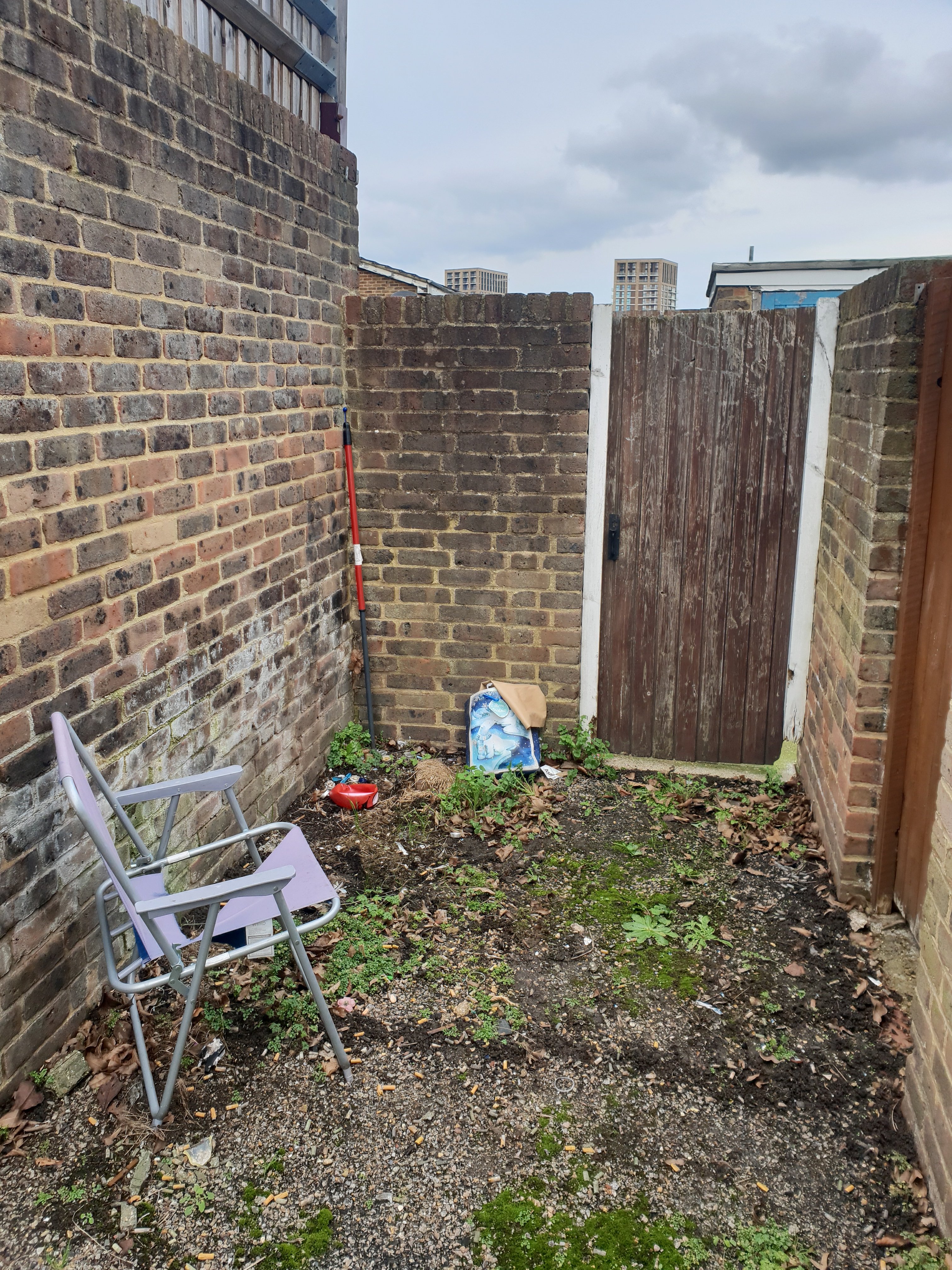
I take an unmarked path between Bloomfield and Burrage Road into a residential area. I turn left down a narrow, walled corridor and get to a crossroads of garden fences. A sorry looking folding chair sits poised with its ripped lilac material, facing someone’s back garden gate.
A discarded Christmas gift bag with a confused looking polar bear leans nonchalantly against the wall, staring at the gate. A red mop handle, ‘Old Red’, contemplates his fate in the corner.
Out of picture are two mop heads, each wondering which one Old Red will choose. Limp desperation is in the air. The tension is really too much.
Something has definitely gone down here.

I scuttle off.

******

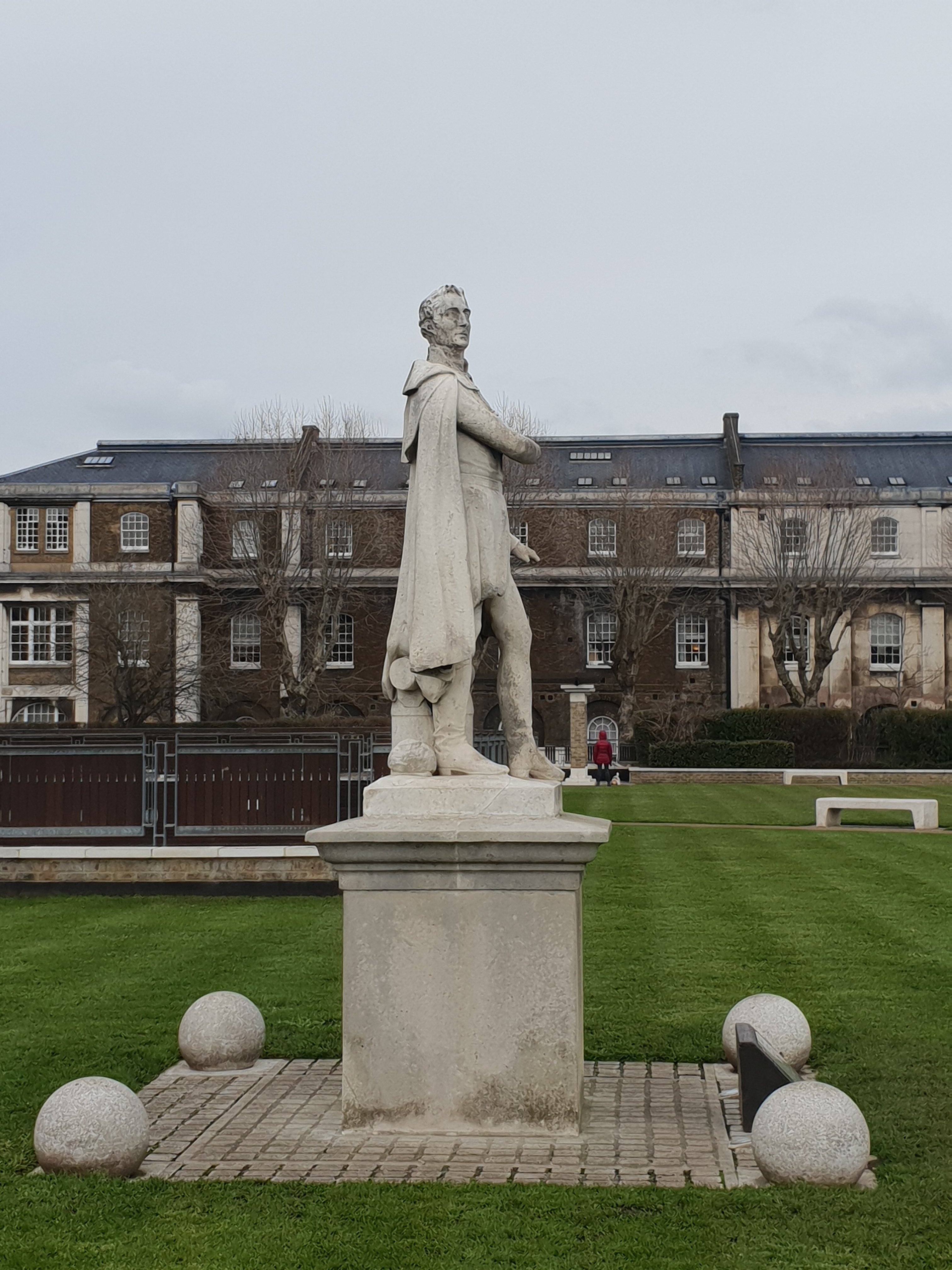
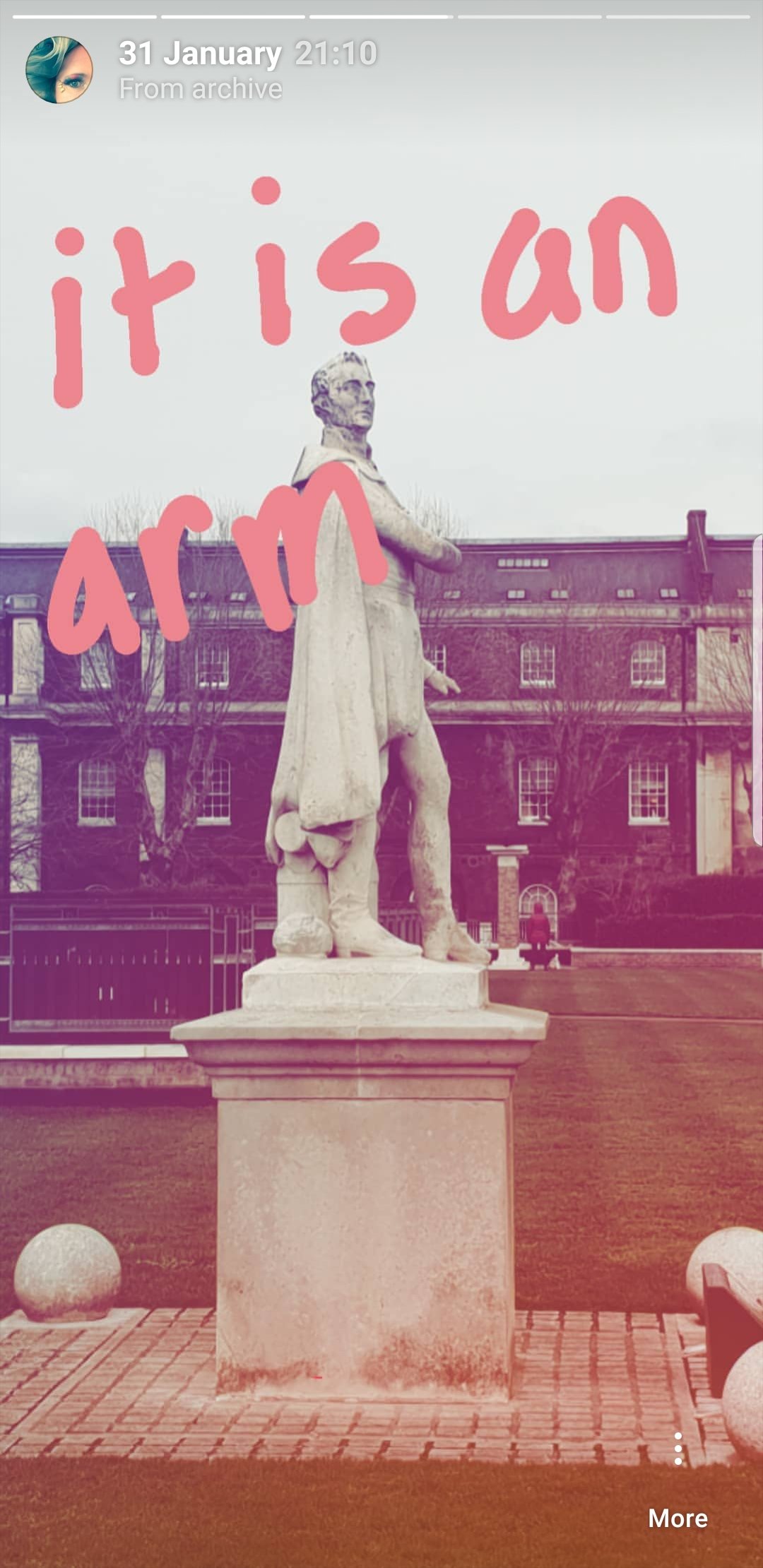
Caught at the right (or maybe its the wrong) angle, the 1st Duke of Wellington is looking most pleased with himself, asserting his grandeur on a plinth that is surrounded by 4 balls. The Duke is peering down on a group of rather miserable looking exercisers who have just finish their workout. There is something superhero about old Wellybobs in his cape. He was Master General of the Ordnance, Royal Arsenal, from 1818 to 1827. I think better of singing an “I saw your winkie” jingle, and wander off. To retain his dignity, I should respectfully note that the statue is best viewed from the front. [I didn’t take any pictures from the front so go see him in person if you are curious].

******

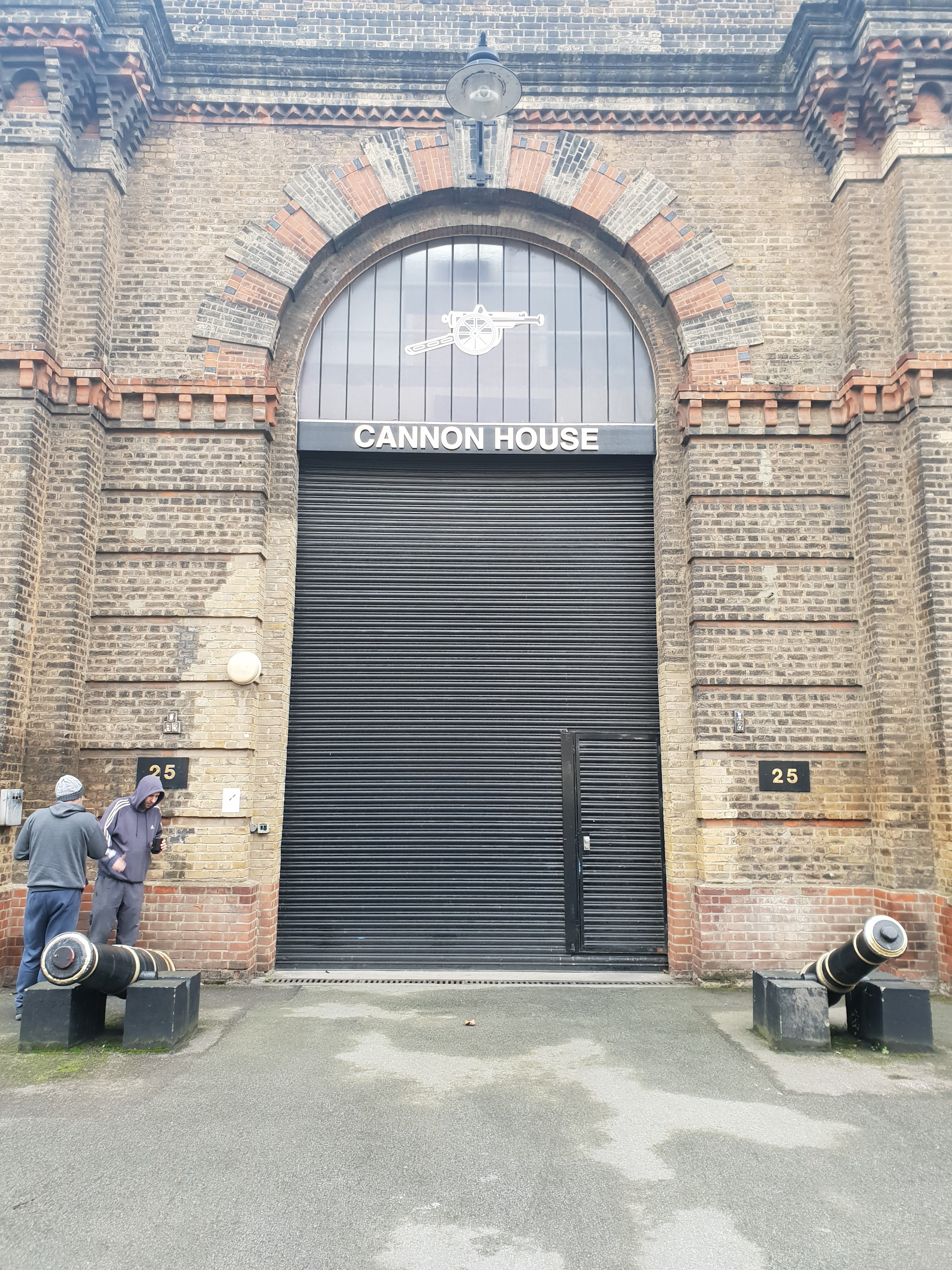
Two guys having a cigarette break loiter in a car park against the backdrop of Cannon Place.

I walk in, past the window of what looks like an office. A man waves and gestures to go to the tiny door within the big door. I think I might be trespassing on private property so I muster a friendly smile and give him the “I’m a local just walking about” spiel. He tells me that Cannon Place used to be a repository for the British Library and that they bought it eight years ago and now its a corporate storage facility. He says I can wander about the car park which is nice of him.

I do this, diligently.

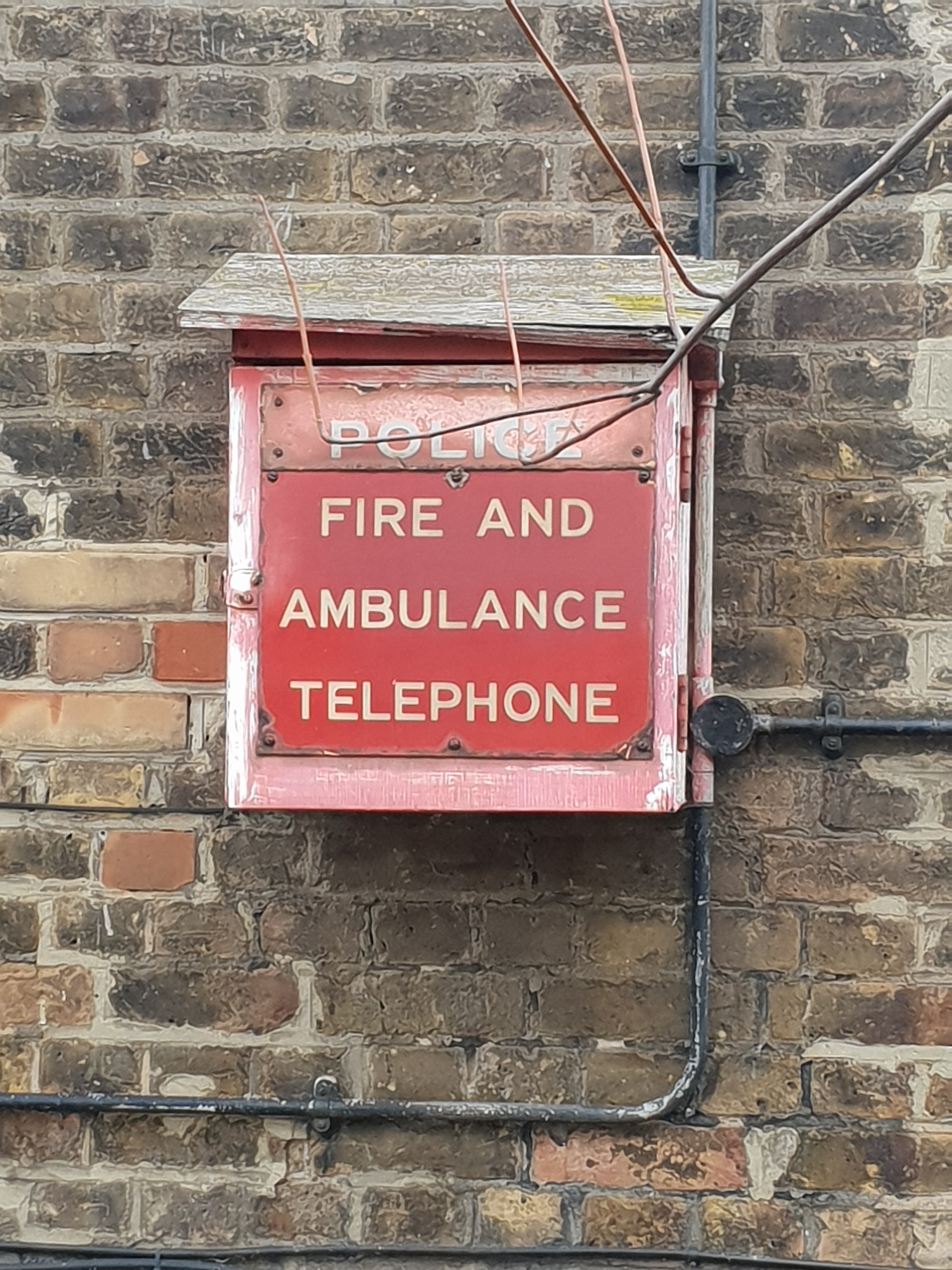
I find an emergency phone.

-ends-

Social

If I learned anything this week it is that nothing beats going to a community event run by local people for local people to connect in person through shared concerns, visions and care for the place we live, Woolwich. And, the last two weeks I have also been mulling over how I use social media to keep up to date with local happenings, and how my own online presence for my artistic practice and research might be helped by interacting with others online. The latter has been prompted by the ‘23 Things for Research: digital tools for your professional and personal development’ course ran by University of Surrey. In fact, the way I found out about this community event was on my daily search “Woolwich” on Twitter.

So, taking a ‘killing two birds with one stone’ approach, at the community meeting led by Speak Out Woolwich I tweeted comments from the speakers to engage with local Twitter accounts as well as having good old fashioned, actual conversations with my Woolwich neighbours. For me, the real-life interactions are what count the most (no surprise there). Yet the support that Twitter (@dizzfort), Instagram (@lizzfort), Facebook, YouTube and LinkedIn can provide help to keep me more informed about local goings on from a range of perspectives, angles and agendas. That said, broadening the diversity of people I follow on social media and engage with removes the potential of being in an echo chamber [only sharing ideas and views with people that have the same ideas and views as me].

In other news, my 24 year old friend Freya showed me how to post an Instagram story (yes I know, late the the party), and so I published a series of photos from one of my walks this weeks, and got ‘creative’ with the 1st Duke of Wellington…

What I haven’t got my head round yet is linking these platforms and being a bit more savvy with regular postings to develop my online community interactions. I found out about using something like Hootsuite for this but I am not sure whether this is right for this project just yet. I also need to starting publishing every 2 weeks on my blog, moving towards weekly to get into the habit of writing regularly. This is, after all, one of the modes of documentation for my practice based research. OK, that’s all for now.

Passage

Crossing over the road from the Powys Street car park to walk to the Waterfront leisure centre I discovered a new (to me) cut through via Mortgramit Square, just to the left of the Grade II listed Art Deco Emporium building.

At this moment I am not on one of my walks. I am in pursuit of a hot shower since the boiler has broken at home.

Yet, yet, as the narrow road weaves to the right, to the left, to the right again, I am in new walking territory.

Mindset shifts to curious, less directional. Walking pace slows.

I can now hear the traffic on the South Circular beyond the buildings to my left. And then, the buildings open up to reveal an alley. Blink and you’ll miss it.

I pause.

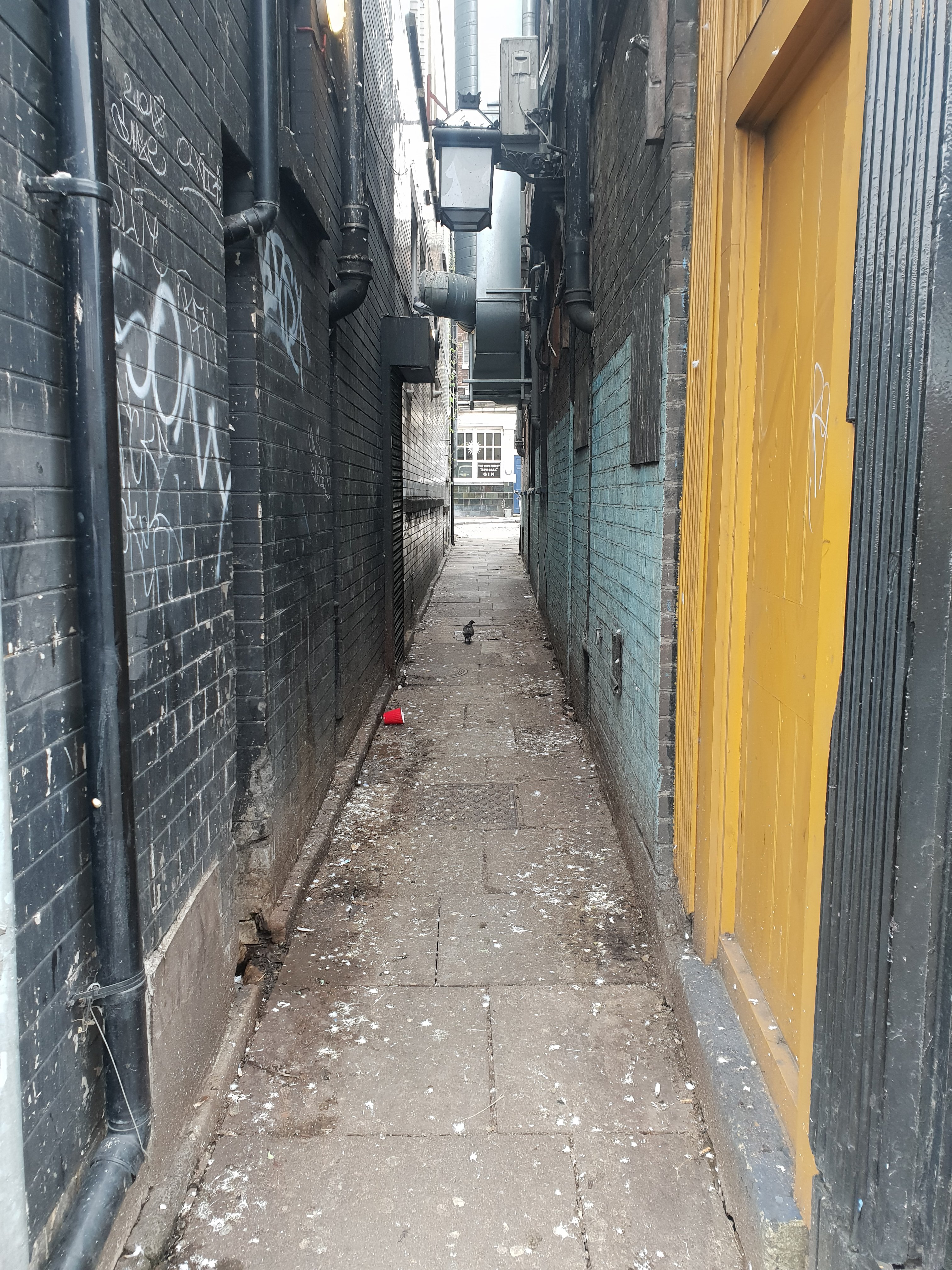
Two pigeons engage in what looks like a courting dance. Well, I think its courting. The male pigeon is strutting, flapping it’s determined wings in pursuit of the demure, aloof female. They seem unfazed by my presence. There is bird shit everywhere.

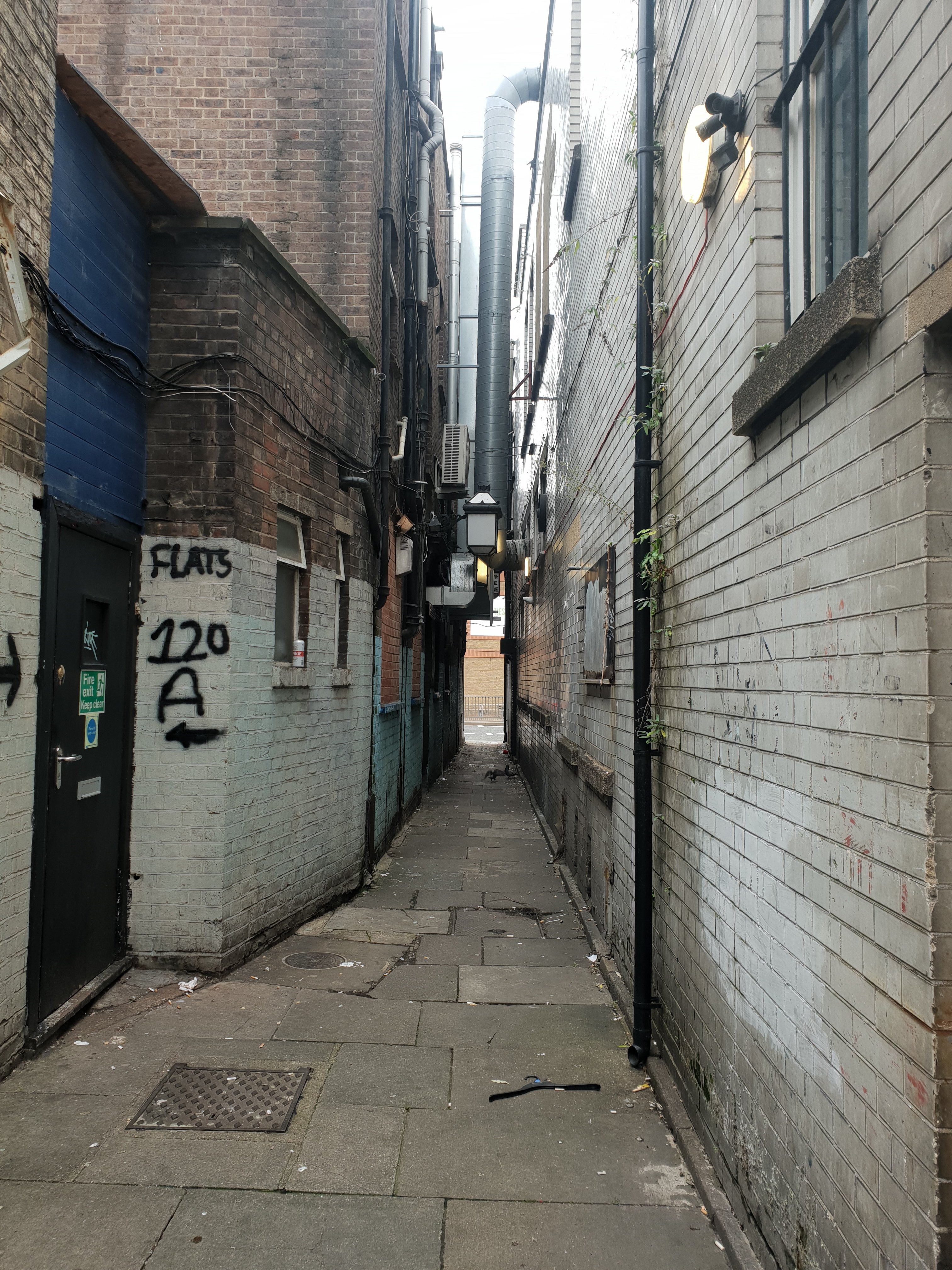
Hood up, I am compelled to walk through this monochrome, dingy, narrow passage that is decorated with splashes of colour; a yellow doorway, bright red discarded cup, faded teal painted wall and grafitti.

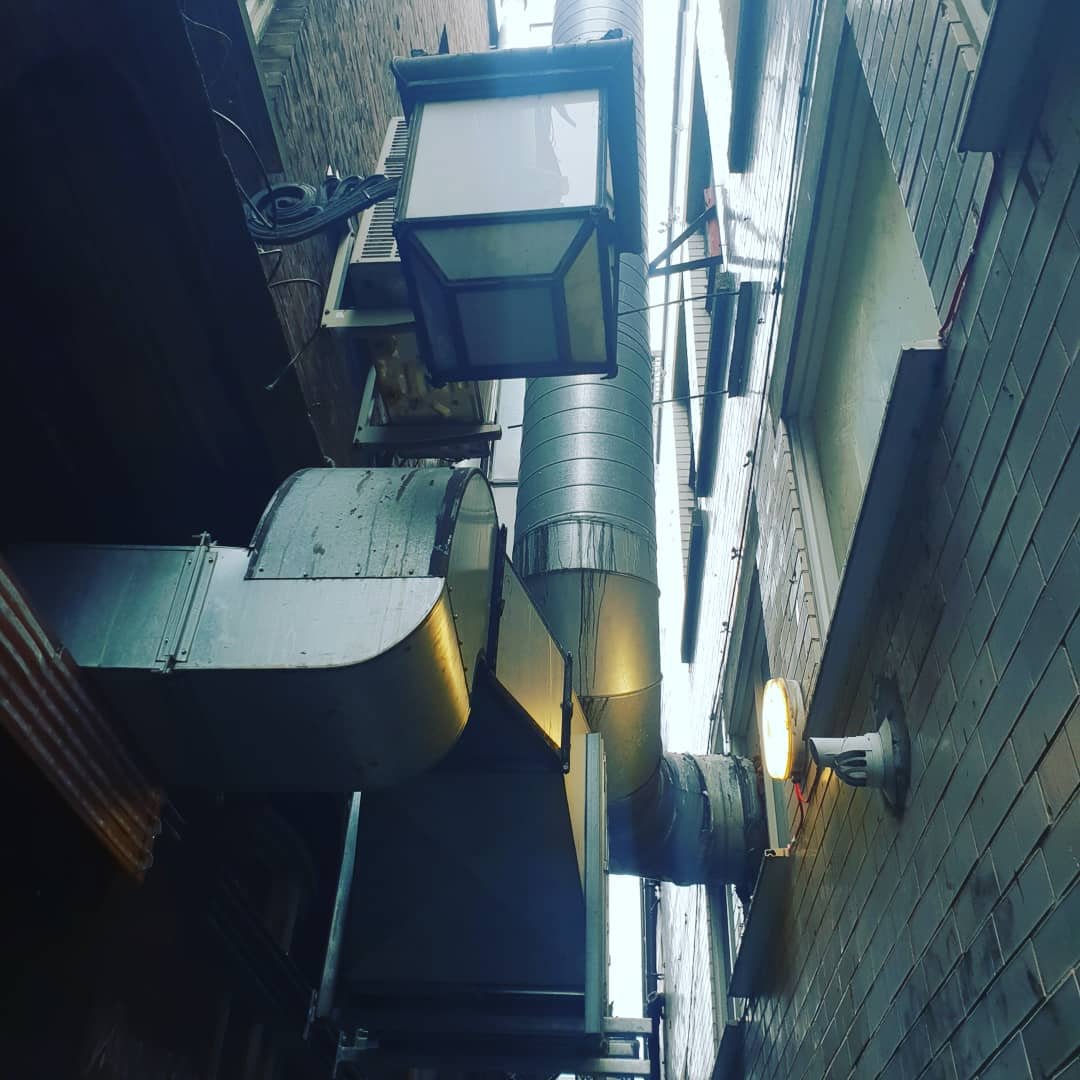
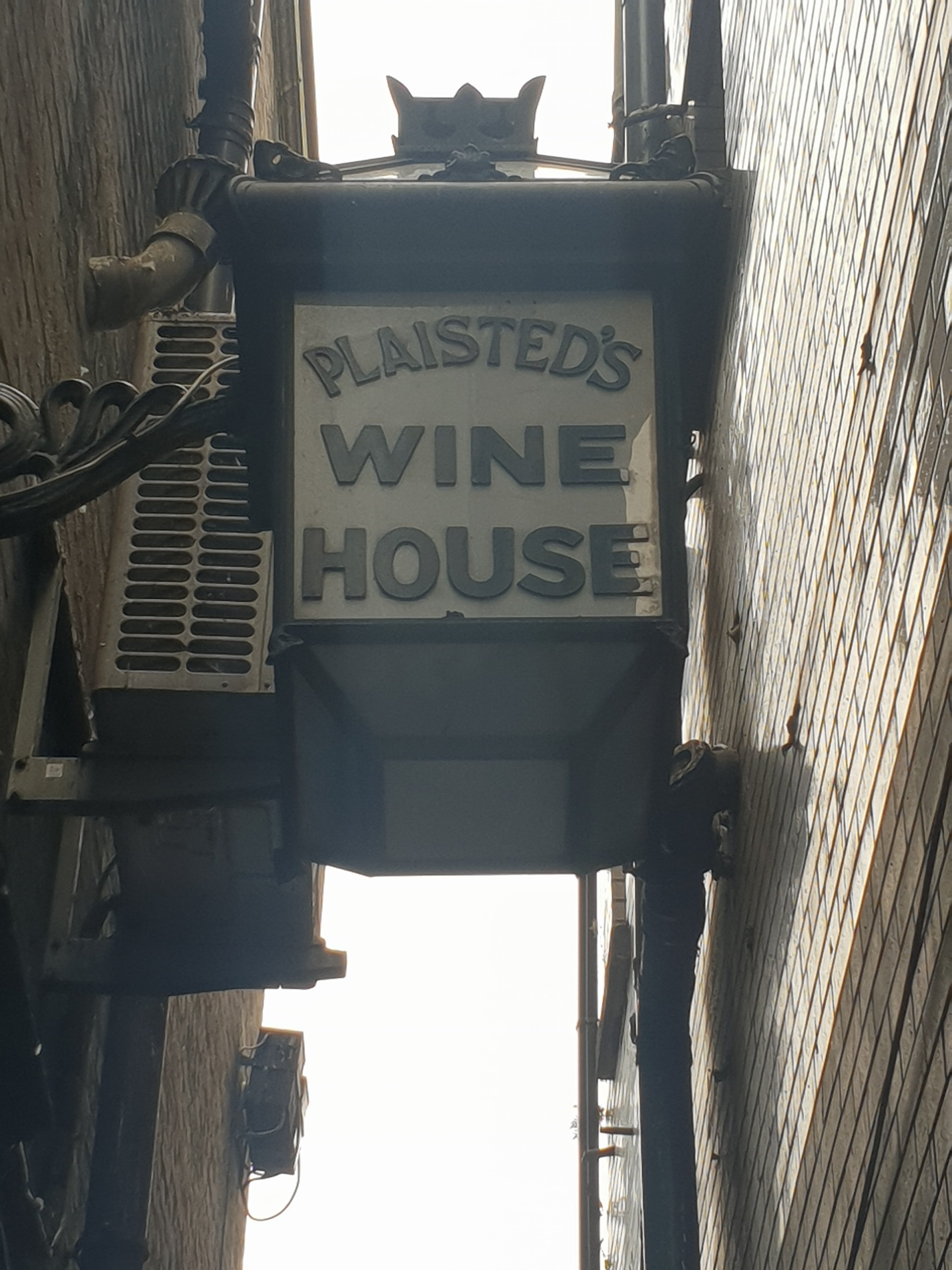
Midway through, mouth closed, I gingerly look up, shrinking slightly. An overbearing industrial maze of pipes, chimney flues and extractors lead you to the grey sky above. A romantic old lantern light confidently asserts the building’s past, “Plaisted’s Wine House” also known as The Coopers Arms, that closed in 2010.

The building is up for sale, most recently host to the Lantern Cafe and Laundrette. I recall drinking coffee in the cafe with Tina asleep on my lap, chatting to the generous columbian owner who gave me spanish omelette with chorizo on the house. I later contacted her about having a birthday party there but regrettably the business was closing.

And so the building’s identity will shift again. Its past will remain in the physical signs it leaves behind. and in the memories of the people who encountered it. In my brief, embodied encounter, I am reminded of Italo Calvino’s writing in Invisible Cities…

“The city, however, does not tell it’s past, but contains it like the lines of a hand, written in the corner of the streets, the gratings of windows, the banisters of the steps, the antennae of the lightning rods, the poles of the flags, every segment marked in turn with scratches, indentations, scrolls” (1972, 1997, p9)

In the palm of Woolwich’s hand are the stories it contains, written in its buildings and nooks and crannies if you look hard enough.

And the pigeons continue to dance and shit all over it.

I cross the road for a hot shower.

References:

Calvino, Italo. (1972, 1997) Invisible Cities. Vintage Classics

Pausing with places & people

Over the last few weeks there have been many reasons to take a few moments to pause during my walks. Pausing to talk to people, pausing to take a photo, pausing to sit, pausing to observe, and pausing to just imagine what a place is, was, or might be. In this first post I’ve included a selection of pauses that are documented through photos and recalled conversations. I am just starting to experiment with autoethnographic writing, but have not reached the point where I am connecting anecdotes and stories to wider cultural and social meanings and understandings. Perhaps some more on this next time.

Thank you for taking a pause in your day to visit my blog.

This slideshow requires JavaScript.

“It’s a dead end” a woman shouts down to me, smiling and pointing from her balcony. I look in the direction I was intending to walk, smile back and thank her. Tina, my dog, is sat looking up at me with a daft smile and tongue hanging to one side. I am now in a dilemma. The explorer in me wants to walk a little further down the derelict path (which I think would be Tina’s preference). But the resident in me wants to respect the warning from my neighbour. I am on unfamiliar territory in this part of town.  I am watched from windows, balconies and parked cars. I am off-roading on the many unmarked foot paths and alleyways that connect the mapped, marked roads on Google Maps. I turn back this time and find another way through, likely to return to the find the very end of the dead end another time.

“Move, you fucking…” he shouts. There is a man walking towards me with a dog that is pulling on the lead to meet Tina. The man’s angry eyes meet mine, he moves sideways off the path in between the parked cars, pulling the reluctant dog behind him. In that split second I simultaneously turn around to walk the other way and then realise that he has moved off the path for me and my about turn continues round 360 degrees to resume my original journey. We pass each other with a row of cars between us. His dog is still looking back at mine. “Come ‘ere…” He aggressively pulls the dog and we walk in opposite directions.

“Can I stroke her” she says. “Of course,” I reply,  “she is very friendly.” “My husband and I want a dog.” She continues to tell me about her partner being retired from the army. “The thing is, I am worried about when their bottom is dirty and they sit down get it on the floor. Is that a problem?” I reassure her that Tina is very clean, and that the only poo incidents were during her puppy months.  I answer more questions about where we walk her, how much walking she needs a day. She introduces herself, goes to shake my right hand, sees the sagging poo bag and I gesture with a nod of my head that the other hand is a better choice. She gently touches and shakes my left forearm and says “nice to meet you Lizzie, I live at number 9. I am just going to my mums to drop some stuff off. Hey maybe if I get a dog we could meet up and walk the dogs together.” I smile and agree and say I look forward to seeing her again.

“Hello” I smile at the man as I cross the road. He has 2 dogs off the lead, going about their business on a grassy patch. Confused, he half replies. “uh Hi…(pause) Get over here…now…I said now…” I jump a little, then realise he is shouting at his dogs with all the [unnecessary] bravado he can muster.

“Hello” I say to a man perched on a wall, reading a newspaper. “Hello love”, he replies.

“Is that a pug?” A lady asks, as she weeds the paving in her front yard. “uh, yes we think so, she’s a rescue.” She continues, “Oh, are you the lady that lives over there?” She points indirectly across the way. “No, I live along Hill Reach.” I reply. “I’ve not been around here before, just exploring that’s all. Do you have a dog?” I ask, “No” she shuts the conversation down. Too familiar I suppose?