
NO LOITERING! (32 minutes)
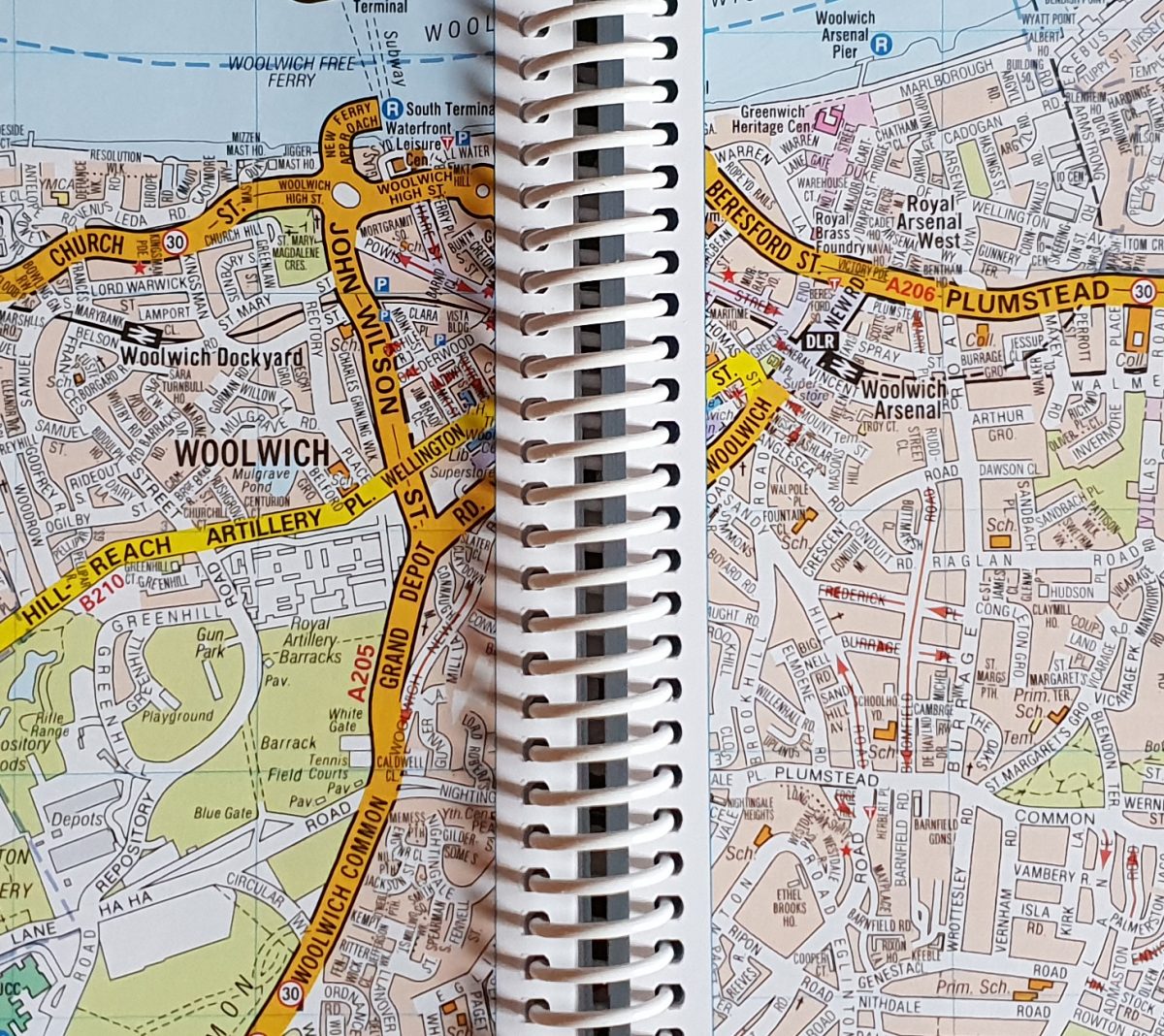
Location: Ministry of Defence land – Repository Woods Area, Barrack Field, Woolwich Common
Transcript
[Music fades in]
This is the Woolwich Wandering podcast, a series of sensory sketches inviting listeners into the vibrant and complex world of Woolwich, a place in South-East London that I call home.
I am Lizzie Fort, community dance artist and researcher, and a resident of Woolwich since 2016.
Curious about deepening the relationship with my neighbourhood, I designed a research project that questioned how dance artists care for people and place.
Through the everyday acts walking, pausing, and resting in public spaces, I worked with local residents who created journals and maps, took part in walking and resting workshops, and wrote a manifesto for Woolwich which was exhibited in the local library.
In each episode, listeners join me on foot as I move, dwell and feel my way through built and natural environments, always mindful of how others have expressed their relationship to our shared neighbourhood.
These are dispatches from a community in flux. Where public land and privately owned public space ambiguously merge.
A battleground where efforts to protect the soul and character of a place rub alongside agendas for the future.
OK, let’s get into this episode.
[Music fades out]
[Bird song]
[Lizzie] This sensory sketch is a journey through green spaces on land owned by the Ministry of Defence in the ward of Woolwich Common which is south of the River Thames and Woolwich town centre.
What follows is a route that loosely traces some quiet spots in the Repository woods area, skirts along the edge of Barrack Field and into Woolwich Common.
My body navigates a varied topography of built and natural environments on foot. The historic military buildings and monuments, housing, roads and pedestrian crossings, locked gates, aggressive red signs, litter and fly tipping, high grasses, natural paths through woodland, dense scrubland, shaded tree canopies and open expanses of sky that host impressive sunsets.
The sound scape fades in and out of wind passing through high grasses and trees, bird song, traffic, clock chimes, horses on training exercises, ambulance sirens and leaves crunching under footsteps.
There are moments of frustration where access is denied or just difficult, where there is a clash of my recreational endeavours with the MOD’s military guardianship of the land. There are spaces where a shift in atmosphere that prompts spontaneous deep breaths [breathe in] and long exhales [breath out] as my body absorbs a new sensation. But mostly, these are spaces where I keep moving, and keep my wits about me because there are few invitations to dwell for long.
[sounds of bird song fades out]
[sounds of car traffic noises and footsteps along footpath]
[sounds of traffic noises fade in and out over the voice over]
I am walking along Hill Reach. It’s a main road that connects Woolwich and Charlton. I come out of my road and cross over, and there is this huge wall. And the wall divides the residential areas on one side with the green spaces of the ministry of defence land on the other. I have to walk all the way up this road onto Repository Road to access this green space there is not gate or access into the green space from the main road. So what should just be literally a hop step out of my house onto a lovely green space, urm, which then connects onto Woolwich common, urr I have to walk up this pretty nasty main road first of all which feels like such a shame.
[sound of a bus waiting at a junction]
At the crossroads of Artillery Place and Francis Street and Repository Road is the Artillery Barracks. I am just walking past the huge mallets mortar. There are many of these cannons and mortars or reminders of Woolwich’s military past and present. You come off the main road into this residential area it is noticeably quieter, greener, calmer.
[sounds of bird song and traffic noise fades]
You start to notice the birdsong as you pass the road of houses on Greenhill Terrace. And you wouldn’t know it unless you had explored a bit further, but just at the end of the houses is an opening into some woodland; I never know whether I am trespassing on this person’s land but I am not on their driveway. I am on the grassy green bit round the edge going into the bushes. There is a lovely natural path that opens up through the trees.
[sound of crunching footsteps on leaves, birdsong, traffic in background]
Its a real mixture of sounds in here. You have got the road just over the way that I was walking up earlier with the big wall that is boundary between the road and residential area and this green space on Ministry of Defence land.
And then right in the middle of this big canopy of trees is a lot more bird song.
[sound of crunching footsteps on leaves, birdsong, traffic in background]
And as you come to the end of the path the space opens out and I can see in front of me a big open green space. Looks like the MOD have cordoned off a section of the land in the middle with electric wire fencing. Perhaps they are doing some rewilding there; the grass is being allowed to grow freely there where as everything else around it is mowed.
[Sounds of bird song and airplane over head]
During one of the Woolwich Wandering workshops I sat here with a group of women for around 10 minutes tuning into the sights and the sounds and the smells of this place. Two of the women had never been here before and one said she had just walked through but she didn’t think she was allowed to stay for too long because of it being on MOD property. They loved hearing the bird and could imagine this to be a place for families to play and picnic. They suggested adding some picnic tables, table tennis tables that kind of thing. I pointed out the private members fishing lake The Dell which was about 100 yards away as well as the Grade 2 listed building The Rotunda that was previously home to the Royal Artillery Museum until 2001. Neither the lake or The Rotunda are open to the public now.
[sounds of airplane overhead fades]
[sounds of wind rustling through bushes, bird song]
I am coming up to a corridor of trees.
Some kind of fir trees I think.
There is a change in the air.
It is much cooler.
There is a gentle breeze running through the trees.
There is a fair amount of litter here [sigh] which I always find surprising because the Ministry of Defence have people that look after the land in terms of mowing, and strimming the hedges. But there is often so much litter and it doesn’t appear like anyone comes to pick it up. I think occasionally they have big clearances.
There is a dog poo bag hanging on a tree that’s been here well over a year now and I always look at it and think ‘Oh I should take that home with me, and then I think ‘oh I haven’t got any gloves’ and every time I come I think ’oh I should have brought my litter picker’. This poo bag is just sat on this tree hanging because someone couldn’t be bothered to take it home. It’s just really lazy.
[sound of footsteps and bird song]
I have now come through the tree covering into what opens out into something that looks like a meadow. You would have no idea you were in London right now. There’s bees and insects flying about. The grass has really grown high, much higher than when I was last here. There is a natural path than runs through, that I really enjoy taking.
[sounds of footsteps through grasses, bird song]
Some of the grasses are nearly as tall as I am.
Not much wind today. Sometimes there is a really strong sound of wind passing through the grasses, bushes and leaves in the trees.
[sounds of wind sounds in the trees. Bird song. Motorcycle noise in the background].
There is kind of a change in the air in this space. It’s a little microclimate of its own.
[sounds of bird song]
And during the Woolwich Wandering project I found others who had also had similar experiences ion this place. Here is local resident Kate.
[Kate] This is gonna sound bizarre when you walk down that that there’s a certain point and you suddenly feel the difference. Because you feel you’re in that [pause silence], do you know what I mean? I’m thinking there must be a word for it; there must be a word for that feeling you get when you’re suddenly in a little sort of valley or sometimes you feel like it when you’re walking through a holloway or a curved path, you suddenly get a feeling where you feel like you’re kind of cocooned in something, that every time I walk down that path I feel it I’m like ‘oh, that’s the moment’ [sigh] I think there’s something about…(pause) I don’t even know if I can even verbalize it, its more of a feeling, that whenever I go to those kind of places, I can almost feel like my whole back, just kind of relaxes. You’re a little bit protected from the wind is a little bit warmer and you’re like, ‘that’s the spot’, must be a word for it.
[sounds of bird song]
[Lizzie] If you want some further solitude here, there is a tree with a huge canopy where the branches hang really low to the ground. Once underneath you are tucked away from view. Engraved on the tree trunk are the names ‘Ryan Jane and Paul’, who perhaps had claimed this space as theirs. I like to think this can also be my space too. I sat under here with the women during our walking and resting workshop and they spent their time quietly in their own thoughts doing tree rubbings, sketches, and photography, some writing. When we chatted, they said they wouldn’t come here alone. But felt safe as a group. For one of the women, Anne Sofie, it reminded her of the trees where children gather around African story tellers and that was really quite a vivid vision and memory for her. Others remarked about it feeling like a magical place for children to play.
[sound of clock chimes in the distance, bird song]
The chime of the bells is a reminder of what this tranquil green space is connected to. Over the road is the Royal Artillery Barracks that were built between 1776 and 1802. Formerly the home of the Royal Artillery, or what was commonly known as The Gunners, this building has the longest continuous façade in the UK at 310 metres long1. You often see the troops practicing their ceremonial choreographies on the tarmac. And the building looks out onto Barrack field – a sports ground that has big red signs along the fence line that say ‘MOD Property’, with a list of rules for the space, one of which is ‘No Loitering’. There is cast iron fencing around this field and four gates. And What’s frustrating is only 2 of these gates are usually open.
The gate from Barrack Field onto beautiful tree lined path would give me a direct route away from the road towards Woolwich Common. But its locked. So, I walk up Repository Road instead, past the home of the Kings Troop Royal Horse Artillery, who regularly walk the horses round the roads in the local area.
[sounds of horse artillery on repository road]
At the crossroads I wait at the traffic lights with Ha Ha road to meet Woolwich Common at the north west corner.
[sound of bus stopped at the crossroads, then bus departing]
Just like Repository woods area and Barrack field, Woolwich common is owned and maintained by the Ministry of Defence. Its surrounded by busy roads on all sides.
Theres Ha-Ha Road that runs along the north end of the common. It is named after the Ha-Ha, the long, linear, wall lined ditch that runs along Barrack Field.
On the west side, over Stadium Road and there is The Greenwich Heights housing Estate that borders Hornfair park. And the Queen Elizabeth Hospital, where we brought our daughter into the world in 2019.
To the south of the common is Shooters Hill Road and the historic buildings of the Herbert Hospital and some new housing there.
The A205 road runs along the east of the common. This borders the publicly accessible Woolwich Common Estate.
When I am stood in the middle of the common you can see that the northern and southern sections of the common are very different in how they look and feel, and how they are used2,3.
The north end of the common is a mainly flat, an open expanse of acid grassland with a horse training paddock for the Kings Troop Horses. I often share this space with loads to crows. They are often in the trees, making a racket. Today they are pretty quiet – spread out looking for ford and morsels, pecking in the grass.
A temporary stadium was built at this end for the London 2012 Paralympic Games. Circuses and fairgrounds pitch here several times a year, and travelling communities often stay few days at a time – well until being evicted by the council.
There is a paved path that runs east to west across this section of the common that is used by pedestrians and cyclists.
[sound leaves under footsteps, ambulance siren in background]
The southern portion of the common is a dense scrub land with beautiful flashes of magenta pink sweet peas, yellow irises, and reeds in the south-east corner where the old reservoir used to be3. It is much wilder here and there is a woodland perimeter which is where I am stood now on one of the natural paths covered by trees immersed in woodland. There is actually a paved path you can take but I always prefer taking this one. Its shady and sheltered and more interesting.
There was an ecological survey commissioned by the local voluntary organisation Friends of Woolwich Common. It listed 29 tree species, over 100 different plants, six types of butterfly, and fifteen species of bird3.
Walkers can explore this wilderness through the natural paths in the covered woods but also in the big expanse of grassland in the middle. There is also a horseshoe shaped path that goes round the end of this south end of the common and a paved walkway that connects east to west.
[sounds of footsteps on a paved path, bird song in background]
[sound of footsteps crunching on leaves]
I am stood in this south end of the common having walked across the paved path that runs west to east and just off the path on the east side is this huge tree. There are squirrels scuttling round. I hear birds in the trees. The wind whistling through branches and leaves is really beautiful. There is a dog barking and the fait sound of traffic in the background.
There are many paths in the common that make it accessible to the public. But there are lots of ongoing concerns about fly tipping, litter, human toileting on the land. There were lots of fires in the hot weather, particularly in the summer of 2022. There has been some unauthorised camping and evidence of drug use on the common. Residents worry about their personal safety here. and I think all these issues contribute to the common feeling like it’s a place you can walk through but not rest of pause for any considerable amount of time.
Many residents I have spoken to in the Woolwich Wandering project discovered this wilderness during the Covid pandemic lockdown, and they had previously just ignored it, or not felt safe to enter on their own.
I spoke to a local resident called Tyron, a deaf, gay man who moved to Woolwich in 2011. Sitting outside his ex-military house, he told me that green and water spaces are really important to him and that they are not visions that come into people’s minds when they think of Woolwich. Tyron discovered Woolwich common by accident during lockdown in 2020. He became a regular visitor, and found his own thinking tree, somewhere he would escape his busy job and volunteering work to sit quietly and reflect. I am stood under this tree now wondering whether or not this was his thinking tree.
Another resident Sofia likes how quiet the common is.
[Sofia] every time I go there, I get this feeling that this is like my garden and how lucky I am and I can’t hear anything, maybe the occasional sirens from the ambulances because they are quite loud. But apart from this, you can’t hear anything once you’re in the middle of it.
[Lizzie] Sofia is a self-confessed Woolwich super fan who loves exploring…but it took her a while to pluck up the confidence walk in Woolwich Common.
[Sofia] Yeah, I know, there have been some incidents in the common or next to the common. And that was actually one of the reasons why took me a while to get the confidence to walk through it. And yeah, it’s very sad. I walked through it. I was with a previous colleague, work colleague of mine, who came to visit and his ex-military, so I felt very safe with him. I was like, ‘Jake, can we go through the common? I would like to explore it, but only if you come with me.’ And once I saw it, then I was like, Okay, fine. I feel like I can come and be here on my own. But it took that effort to find my ex-military friend to take me there.
[Lizzie] Kate, who you were introduced to earlier in this sensory sketch also reflected on how the common is associated with crime, citing the tragic death of an 18 year old Cameron Murfitt in March 2020. Here she is reading from her journal for the Woolwich wandering project…
[Kate] This is a memorial on the edge of Woolwich Common. An 18-year-old man was stabbed to death. He was murdered 8 days before the first lockdown. I remember the day he was murdered because I saw the air ambulance on the bus on the way home Almost a year ago. His memorial is kept beautifully. But his death and lockdown are intertwined in my head.
I got to know Woolwich Common during lockdown. I ignored it before. It turns out it’s full of wildlife. In summer it’s saturated with colour. In Winter muted and calm. It’s a resilient space. Its Survived illegal camping, fly tipping, fires. Like much of Woolwich it’s scarred but beautiful.
[Lizzie] Some residents came together in 2019 to create the local volunteer group, Friends of Woolwich Common. The volunteers organise a monthly litter pick, which is coordinated with the MOD; volunteers leave bags of litter at an agreed location and the MOD collect and dispose of it. I’ve taken part a few times, and my daughter has taken part too and she always points out ‘the litter picking place’ every time we pass it which I think is just amazing. This brilliant organisation have also commissioned a Tree Audits, a Habitat Map, and Species List, Ecological Survey and Management Plan. They got funding to a sign up with information and the common’s history and use. And They successfully lobbied the council to close Circular Way, which was a popular route for fly tippers.
[sound of sirens]
When I visited the common with a group of women in September 2022, our walk coincided with a travelling community who were residing there for a few days. They had caravans, cars and several bright, orange, wood chipping machines. The presence of travellers sparked more curiosity than concern for the women I was walking with.
We had unpleasant encounters dodging human faeces, and toilet paper along the secluded natural paths. We passed piles of litter and woodchip illegally dumped on the east side of the common. And there were muddy tyre tracks carved into the grass marked the vehicles journey off Woolwich Common Road to the traveller’s camping location.
But the women were compassionate about the travelling community’s situation, frustrated that the council or MOD did not provide portable toilets and bins for the visitors. I had started to notice that each time travellers camp on the common, usually people take to Twitter to complain about the mess that is left. But the Twitter conversation does not reflect how this community are marginalised, since there are laws that limit what amenities can be provided on land that is not designated an official camping site. Just a few days after my walk with the group of women, the council issued a statement to confirm the court summons for the travellers had been issued and they had to vacate the land, and they did so the next day. This cycle seems to repeat on every visit.
[bird song, gentle breeze]
From the people I have spoken to, and the views expressed on social media, and my own experiences, Woolwich common appears to be a much-loved green space full of wildlife that people enjoy for walking, running and cycling through, but does not invite pedestrians to hang around for long. As such it feels transient, a place of moving, and not for dwelling.
Woolwich Common has no public toilets or drinking fountains, no picnic tables, a few scattered, broken benches in need of repair, and a few bins. The roads and a deficiency in safe road crossings make for an unpleasant and uninviting gateway to the common – traffic speed, smells and sounds create sensory boundaries. The litter and fly tipping makes the common feel dirty and uncared for, and this contributes to it feeling unsafe. Although the efforts by Friends of Woolwich Common have to be commended since they do a really excellent job of protecting and advocating for this place.
This public place has huge potential to offer the residents that live nearby and further afield somewhere to come together to play, to socialise, relax and rest. Much of the current regeneration work is in Woolwich town centre. What if the council and the Ministry of Defence invested more money beyond the town centre, drawing more people to cross the different zones and territories of Woolwich. Encouraging strangers to meet in liminal, public spaces and spend time alongside people they don’t know.
Common land is after all, supposed to be for common use. The public have a right to roam here, but the conditions of the common are limiting its potential as somewhere to slow down and rest for a while.
[Bird song]
[music fades in]
In the next episode I am in the centre of Woolwich on love lane at the Woolwich centre library.
For more information on the Woolwich Wandering project or to contact Lizzie directly with comments, responses and suggestions, visit www.woolwichwandering.com,
Resources that have informed the making of the sensory sketches can be found in the show notes.
Thanks for listening.
[music fades out]
Show notes
This podcast was created, recorded, and produced by Lizzie between August and December 2023.
With thanks to the research companions who contributed their voices to this podcast, Sofia and Kate. Research companion reflections and contributions are included with consent.
Friends of Woolwich Common – https://friendsofwoolwichcommon.org.uk/
Friends of Woolwich Common reports and resources – https://friendsofwoolwichcommon.org.uk/documents/maps/
Sources consulted:
- Bedford, K. (2014) Woolwich Through Time. Gloucestershire: Amberley Publishing
- Newsome, S. and Williams, A. (2009) Woolwich Common, Woolwich, Greater London: An Assessment of the Historic Environment of Woolwich Common and its Environs. NGR: TQ4280 7724. English Heritage. Available at: https://historicengland.org.uk/research/results/reports/5830/WoolwichCommonWoolwichGreaterLondon_AnArchaeologicalSurveyofWoolwichCommonandItsEnvirons.
- Vickers, D.J. (2022) ‘Woolwich Common: Ecological Survey & Management Plan, April 2022 – March 2027’. Available at: https://friendsofwoolwichcommon.org.uk/documents/maps/.
Music – ‘In the City’ by Oleksii Kaplunskyi from Pixabay https://pixabay.com/users/lesfm-22579021/
 woolwich wandering