“Woolwich is a slightly crazy, colourful clothes wearing alcoholic dysfunctional aunt that you look forward to seeing. She has great stories and makes you feel warm, but you wish she’d get some help. She has a calm peaceful side that not many people see.”
Woolwich Wandering Research Companion, Journal, May 2021
20 February 2024
Dear Royal Borough of Greenwich
This Open Letter is one of the outputs from a local, artistic practice PhD research project, Woolwich Wandering (2018-2024)[1] facilitated by Woolwich resident Lizzie Fort. Driven by Lizzie’s evolving artistic walking/wandering, pausing and resting practices, and ongoing work as a community dance artist, this research project positioned care front and centre of her practice. Asking ‘Am I Wanted Here?’ , the research explores the possibilities, tensions and knowledge that arise when an artist, resident and researcher considers the relationship with their neighbourhood. Woolwich Wandering has been an intimate, sited, artistic experiment, offering temporary spaces of encounter for Woolwich residents.
The purpose of this Open Letter is to share some care-full, embodied, and sensory perceptions of how Woolwich looks and feels, a collective sentiment galvanised from 25 residents who contributed to the project. It is hoped that these insights might, in some way, contribute to the council’s oversight of the regeneration of Woolwich to raise awareness of some deeply felt concerns and hopes for the future.
A brief note on the creative research activities, tools, and the project outcomes
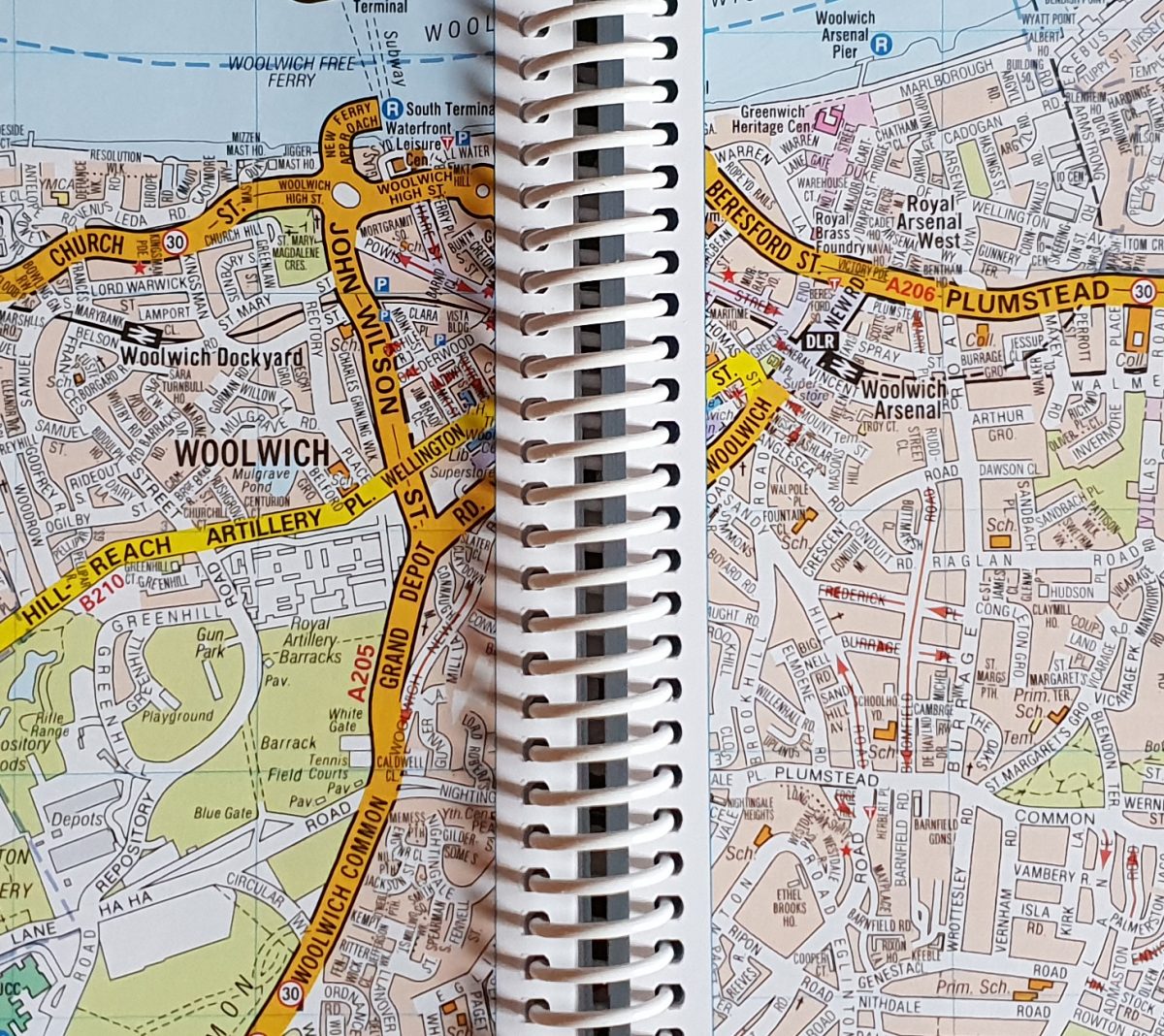
25 residents contributed to this artistic practice project as companions in this research. During the Covid-19 pandemic in 2021, they walked alone and in their social bubbles, and kept journals, took photographs, created maps, and walk routes to document their relationship with Woolwich, followed by one-to-one online conversations with Lizzie. A few companions met in October 2021 for a wander on Woolwich Common and Repository Woods, followed by a chat at The Woolwich Centre library. Research activities continued into 2022, with four walking-resting workshops across the town centre, Royal Arsenal Riverside, Thames Path, Woolwich Dockyard and Woolwich Common areas. Each workshop closed with the writing of care manifesto statements about Woolwich. The fieldwork concluded with a public exhibition at The Woolwich Centre, November to December 2022, displaying the companions’ contributions, as well as a draft Manifesto for Public Space.
Other products coming out of the research include an Interactive Map[2], and a podcast series ‘Sensing Woolwich’[3] that present the research findings in novel ways. The project materials are documented on the Woolwich Wandering Website. The final, forthcoming written thesis will be submitted for examination in early 2024, with a viva (a conversation with examiners) expected in June 2024. The thesis will be made public after the examination process is complete.
We are aware that this letter and manifesto comes after the initial community consultation on key themes for the new Local Plan has passed and look forward to contributing feedback on the first draft of the Local Plan to be published in 2024.
A Care Manifesto for Public Space[4]
We are a small but mighty group of residents who, collectively, recognise that Woolwich is a wonderfully complex and contradictory urban place.
Woolwich is “diverse”[5], “vibrant”, full of “character”, “soul” and “personality”.
Woolwich is also “divided”, “troubled”, “scarred”, “neglected”, “gentrified”, “menacing”, “embarrassing”, “needing some help”, “dirty”, and has a “bad reputation.”
Woolwich is our neighbourhood.
We care about Woolwich, deeply.
We want future generations to feel part of this community and be proud of where they live.
Here is our care manifesto.
We care about green and water spaces. They are vital for our wellbeing, pleasure, and sense of connectedness to our community and nature. But our time, pleasure, and comfort in spaces such as Woolwich Common, St Mary’s Gardens, Maribor Park for example, is dampened because there are no public toilets and drinking water fountains. Better facilities please.
We care about borders NOT barriers. The public realm feels fragmented and disconnected. It is characterised by physical and sensory boundaries such as the smell, noise, and speed of traffic on roads, insufficient safe road crossings, badly lit, vandalised, smelly, and unsafe underpasses across the A206, high walls, fences, and locked gates. These boundaries negatively impact community connection, walkability, and our sense of place.
We care about places and worry about place-lessness. We recognise that regeneration is needed. But question whether developments are sympathetic to the diversity and vibrancy of our neighbourhood. Some of us recognise we are “middle class incomers”, contributing to and benefitting from gentrification of the area. We are not resting on our laurels. It is not ok for Woolwich’s long-standing communities to be displaced, or for them not to feel welcome in ‘new’ developments. Please support local, independent businesses and bring the high street back to life. And, when old buildings are demolished to make way for new developments, make sure those businesses that serve our global community are rehomed locally, with care.
We care about slowing down. Prioritise rest in public space. Moving and dwelling are off kilter. Moving dominates. Expand pedestrianised areas and 20mph zones, de-prioritise cars, build more safe road crossings. Accessible public spaces should have more invitations to pause and rest in safety and comfort throughout the seasons, without the need to spend money. More seating and tree shade would be a start.
We care about cleaning up Woolwich. Litter and fly tipping is a blight on our public realm and makes us feel embarrassed to bring our friends and family here. Royal Arsenal Riverside is pristine…what about the other side of the road?
We care about beautiful buildings. We have had enough of boring!We want to project heritage and see aesthetic variety. Build affordable, but NOT boring housing. No more “identikit” and “vanilla” buildings that are wounding Woolwich’s much celebrated character, and are bad for communities, our health, and the environment[6].
We care about spending our money in our neighbourhood. Support local independent businesses, not just well-known chains, to improve the retail, hospitality, and leisure facilities.
We care about feeling safe. We want to acknowledge and learn from tragic events of the past, such as 2011 London Riots, the murder of Lee Rigby in 2013, and more recent fatalities such as Cameron Murfitt (2020), Tamim Ian Habimana (2021) and Damilola Oloruntola (2022). Women should not have to walk home in the dark, clutching their keys in self-defence.
To close, we want to protect the global community of Woolwich, its character and variety of green and water spaces and heritage buildings, its entrepreneurial spirit, and independent businesses. We want to see it develop as a place that nurtures health, wellbeing, play, pleasure, prosperity, and togetherness. We envision a place where our diverse community can thrive.
In solidarity,
Lizzie Fort (lead artist-resident-researcher) in collaboration with,
Alexis Bailey, Anne Sophie Konan, Bianca Rus, Carol Flint*, Debbie Williams**, Duncan Platt, Ian Russell, Karin Tearle, Kate Topham, Lam Truong, Laura Love-Petschl, Lesley Turner, Liz McGine, Lucy George, Lyan Truong, Melloney Richards Tarka, Molly Rose, Patreace Parkes, Patricia Roud, Prince O Adele, Seiriol Davies, Sofia Alexandrache***, Tyron Woolfe, Anonymous1, Anonymous2, Anonymous3
[*Has since moved away. / **visitor, not a local resident. / ***Has since moved to another part of the Borough]
[1] https://woolwichwandering.com/. Funded by Arts and Humanities Research Council through the Techne Doctoral Training Partnership.
[2] https://woolwichwandering.com/interactive-map/
[3] https://woolwichwandering.com/podcasts/
[4] The concept of a care manifesto is borrowed and adapted from People United’s Futures of Care Manifesto. https://peopleunited.org.uk/stories/futures-of-care/futures-of-care-manifesto/
[5] “quoted” vocabulary from Woolwich Wandering research companions.
[6] See Building Soul with Thomas Heatherwick, https://www.bbc.co.uk/programmes/m001r1b2
 woolwich wandering