
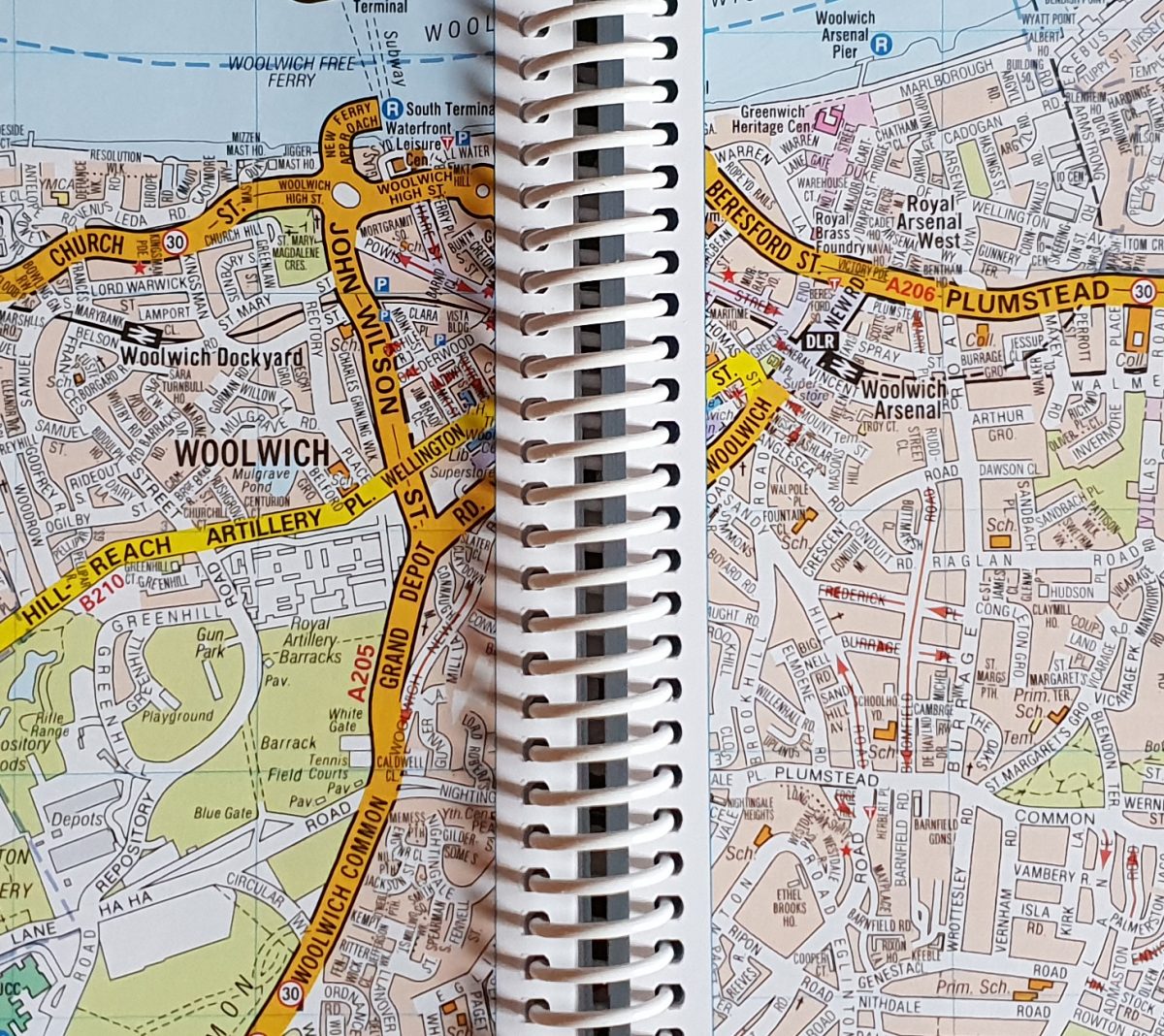
Walking to Woolwich Common last week (10.12.2020) I started to think about the relationship between walking and writing and the type of writing that might be useful at the moment. I had been flirting with the idea that there is a relationship between walking and writing, one step after the other, one word after the other, with pausing on walks acting as a sort of punctation. I wondered about writing in way that conjured the rhythm of walking for the reader and how words on a page might be designed to visually enhance this embodied sensation during the normally sedentary activity of reading.
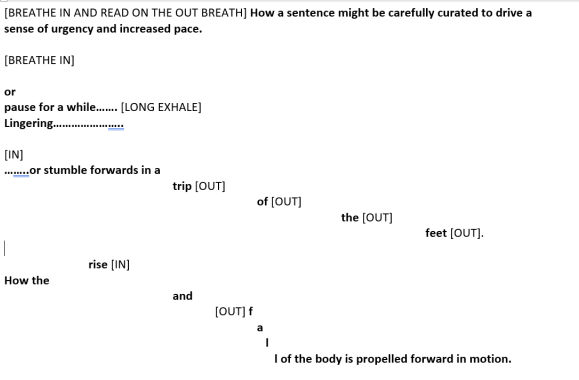
And so, the words are choreographed on the page with breath prompts to somehow communicate for the reader an embodied representation of the walk itself.
Tricksy.
I am not sure if it works.

 woolwich wandering
lovely to read this Lizz. A lot of my time these days is spent editing: editing words (and editing video). I wondered where editing might fit here. What might editing a walk look and feel like?
LikeLike
thanks Simon. I have found myself reading and re-reading this comment and looking at my post, and thinking about it in circles. Short answer is I don’t know at the moment. Some vague stabbing-in-the-dark-type rambling thoughts have been about editing as something that happens 1. during and 2. after the walking.
1. Editing during walking – If editing is considered as correcting/condensing/modifying (quick dictionary definition search)…
*Correcting – this might suggest there was something wrong with the walk in the first place that I need to put right. Or, the body is in a constant process of correcting itself through balancing and staying upright and in forward motion during a walk. The body involuntarily edits itself constantly with muscles acting antagonistically to support the body and its gait. On a straight-forward footpath this is a combination of unconscious involuntary actions humming away and voluntary actions to avoid obstacles or make a quick dash to avoid getting run over, for example. More tricky terrain requires more conscious thought for motor control of the body. So this way of thinking about correcting-editing walking is happening all the time whether we are aware of it or not.
*Condensing – this would suggest I am shortening the walk in some way. Leave that one with me.
*Modifying – this suggests I change something about the walk in-situ. The route, the style of walking, the purpose of the walk, the score/rules for the walk. Modifying is normally an improvised and a mostly spontaneous editing type process for me. Modifying will vary depending on whether I am lost in thought or very focussed on where I am and where I am going. Modifying-editing a walk feels like a conscious process since during a walk we make decisions about how to walk, where to walk, where to pause, where to deviate, what to take photos of. Editing/improvising might interrupt the flow of the walking patterns of the body and the thinking patterns and take me in another direction.
2. Editing after walking –
Editing a walk after the walk has happened. Well this seems to be a process of documenting the walk somehow. A bit like I did in this post. And so editing a walk becomes a reliving of the sensory embodied walking experience. I make choices about what to document and how to document it. I think about the person on the receiving end of this communication – a reader/listener/watcher. What do I want to communicate and how? And so, after the walk has happened, the documenting process is an editing process too, since I am selecting/condensing/modifying the walking experience into another format (or perhaps this is translating or adapting and not editing at all?) In this case I want communicate more than simply the narrative and the route. I want to communicate more of the sensory and embodied elements – Tim Edensor’s writing about his walking in industrial ruins has helped with this. I have been writing about improvisational walking and encounters with incongruent objects and how they jolt me out of my walking flow and thoughts.
LikeLike
Nice. I wasn’t so sure my question was useful so much as an initial response. But hopefully you get some mileage out of it (or just trash it completely). 😉
LikeLike